Imagine buying a house and being told that, actually, you're just renting it, and that the landlord can take it back at any time without warning. That's the uncomfortable reality of traditional domain ownership. You pay for it, you build on it, and yet you never truly own it. Now imagine a world where that changes entirely: where your digital address is yours permanently, censorship-proof, and stored on a decentralized ledger that no government or corporation can touch. That's the promise driving millions of people to explore Web3 domains, and it's exactly why the conversation around them is heating up fast.
But what is the purpose of Web3 domains, and how do they actually differ from the traditional domains we've used for decades? The answer goes far deeper than new extensions and crypto hype. It touches on ownership rights, internet freedom, digital identity, and the very architecture of the next generation of the web. Whether you're a business owner, a developer, or simply someone curious about where the internet is headed, understanding the distinction between these two systems is no longer optional — it's essential.
What Are Traditional Domains?
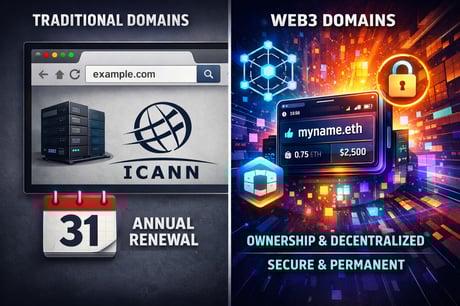
Traditional domains operate through the Domain Name System (DNS), a centralised infrastructure often described as the Internet's phonebook. When you type a web address like example.com into your browser, the DNS translates that human-readable name into a numerical IP address that computers use to locate the correct server. The Internet Corporation for Assigned Names and Numbers (ICANN) oversees this system, which manages the security, stability, and global consistency of the DNS framework. Traditional domains come in familiar extensions such as .com, .org, .net, and thousands of newer generic top-level domains (gTLDs).
What Are Web3 Domains?
Web3 domains are a fundamentally different kind of digital address. Rather than living on centralised servers managed by registrars, they are stored on public blockchains, such as Ethereum, Solana, or BNB Chain, as non-fungible tokens (NFTs). This means ownership is cryptographically verified and tied directly to a user's crypto wallet, not to a company or registry. Popular Web3 extensions include .eth, .crypto, .nft, .sol, and .wallet. According to the Global Domain Report 2025, the number of Web3 registered domains surged to 9.2 million in 2024 — still a fraction of the 364.3 million traditional domains, but growing rapidly.
Ownership: Renting vs. Truly Owning
The most fundamental difference between the two systems is ownership. With a traditional domain, you do not truly own it; you rent it from an ICANN-accredited registrar, typically on an annual basis. If you forget to renew, a government intervenes, or a legal dispute arises, the domain can be suspended, transferred, or seized. The registrar holds ultimate authority.
Web3 domains flip this model entirely. Once minted on a blockchain, the domain is permanently linked to the owner's crypto wallet. No central authority can revoke or transfer it without the holder's private key. Because all transactions are publicly recorded on the blockchain, ownership is transparent and independently verifiable at all times — a landmark shift for anyone who values true digital property rights.
Cost Structure: Annual Fees vs. One-Time Purchase
Traditional domains require yearly renewal fees. Forgetting to renew even once can result in losing a name, sometimes to competitors or domain squatters. Web3 domains, by contrast, offer a buy-once, own-forever model. There are no annual fees or recurring payments. Once minted, the domain remains in your wallet indefinitely, making it a more cost-effective long-term holding for investors and creators alike.
Censorship Resistance and Control
Traditional domains are vulnerable to censorship. DNS providers, governments, and courts can block or revoke domain access, even for legal content in certain jurisdictions. Web3 domains, hosted on decentralised storage systems like IPFS, are designed to resist such interference. Because no single entity controls the namespace, the domain stays online regardless of external pressure — a critical feature for activists, journalists, and decentralised finance (DeFi) projects operating in restrictive environments.
Functionality: Beyond Just a Web Address
Traditional domains serve one primary purpose: routing users to a website or service. Web3 domains are far more versatile. They can act as a simplified crypto wallet address (e.g., yourname.eth instead of a 42-character hash), serve as a universal login for decentralised applications (dApps), host decentralised websites, and even function as a portable digital identity across blockchain ecosystems. In this sense, Web3 domains are less like a home address and more like an all-in-one digital passport.
Limitations and Mainstream Adoption
Despite their advantages, Web3 domains face real barriers to widespread adoption. Most standard browsers — Chrome, Safari, Firefox — do not natively support Web3 domains. Users typically require a Web3-compatible browser like Brave or a separate plugin. Additionally, configuring wallets and decentralised DNS records demands a level of technical knowledge that remains out of reach for many everyday users. Traditional domains, in contrast, work seamlessly across every device and platform on earth. For businesses targeting general consumers, a .com or country-code domain still offers far greater visibility, trust, and compatibility.
Conclusion: Two Systems, One Evolving Internet
Traditional and Web3 domains each serve distinct purposes rooted in the architecture of the internet they belong to. Traditional domains remain indispensable for mainstream web presence, universally accessible, deeply established, and backed by robust legal and dispute-resolution frameworks. Web3 domains, on the other hand, offer something the old system never could: true digital ownership, censorship resistance, and multi-functional utility as a decentralised identity layer.
For most individuals and businesses today, a traditional domain remains the practical, high-reach choice. But as blockchain adoption grows and browsers evolve to support decentralised naming natively, Web3 domains will become a standard part of how people establish their online presence. The smartest strategy for investors and builders alike may be to secure a foothold in both worlds.