

94%
Valuation accuracy — AWN AI system
"Software isn't finished when it launches. It's finished when the business no longer needs to think about it."
Most software agencies measure success at launch. We measure it differently. Built to Last™ is the framework we apply to every EB Pearls project — not as a premium tier, not as an optional upgrade. As the standard. Because we've seen what happens when these foundations are missing, and we've spent 20 years learning what it takes to build software that genuinely lasts.
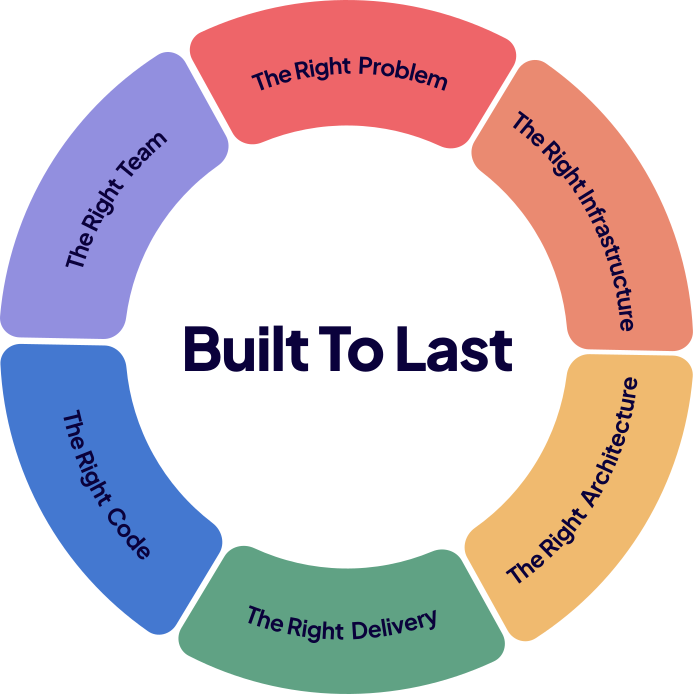
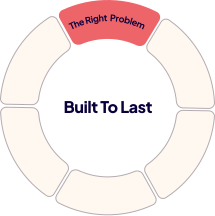
Most AI projects fail because "use AI" isn't a problem statement. The failure pattern is consistent: a business sees what AI can do, builds something technically impressive, and discovers six months later that it doesn't move the metric that matters.
Before any model is selected or any data pipeline is designed, we map the real problem — its commercial cost, the outcome a successful solution would produce, and whether AI is actually the right answer.
⚠ You're missing this if:
"From the first Discovery Session, EB Pearls brought clarity to complexity. They helped us prioritise features, align on technical feasibility, and co-design a roadmap that actually made sense." — Andrew Penn, Board Advisor · CryptoNest · Melbourne
A deliberate interrogation of the problem: its commercial cost, data availability, accuracy requirements, and whether AI is the right solution.
Is the problem real and commercially significant? Is the data available, clean, and legally usable? What does "good enough" accuracy look like?
An audit of the data your AI will depend on volume, recency, labelling status, and legal usability. This surfaces that risk before a model is selected.
Accuracy thresholds agreed upfront. What happens when the AI is wrong, and who is accountable.
A structured map of the use cases where AI creates genuine business value. Prioritised by ROI, data readiness, and delivery risk.
Every automated decision with commercial needs a defined human escalation point. Especially critical for regulated industries.
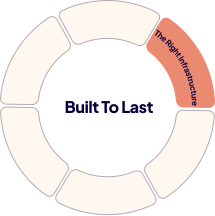
AI infrastructure has failure modes that standard software doesn't. A single inefficient query pattern can multiply across millions of API calls. A model that performs at demo scale fails under real traffic. Cost monitoring configured after launch is always too late.
Designed for production load from sprint one. Not retrofitted after the first incident.
"What impressed us most was that support did not stop at launch. When issues came up, they were responsive, clear, and easy to work with. It felt like we had a partner behind the product." — Matthew Baker, Product Manager · EML
A pre-launch review covering model performance, cost monitoring, data sovereignty controls, drift detection setup, and escalation paths.
Configured before the first user arrives. Token usage, API call patterns, infrastructure spend — all monitored with thresholds that alert before costs spiral.
AI degrades silently. Drift detection configured from sprint one so accuracy degradation is caught before users experience it.
Audit trails for every automated decision. Who triggered it, what the AI decided, what data it used, and when.
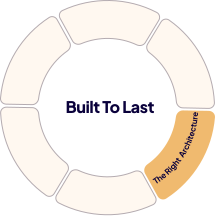
RAG or fine-tuning? Agentic or retrieval-based? Which foundation model? These decisions compound. A system built on the wrong architecture doesn't just perform poorly — it becomes expensive to change and impossible to upgrade without a rebuild.
Every architecture decision made deliberately, before development begins. Not discovered as a conflict six months into a build.
"As usage grew, our app kept up. The foundations were strong from the start, and that gave us confidence as the business grew. It was one less thing to think about." — Shimneet Chand, Product Manager · Vodafone Fiji
Every architecture decision tested against three horizons: does it work at today's volume, does it hold at 10x scale, and does it remain upgradeable as the model landscape evolves?
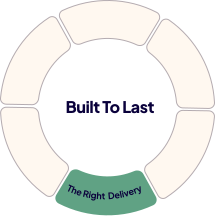
AI delivery has a unique failure mode that standard software doesn't: accuracy can drift mid-build. A model that hits benchmarks in sprint three may miss them in sprint six as the data changes or the use case evolves.
Every sprint ends with working AI tested against accuracy benchmarks — not status reports. Leadership always knows where the system stands.
"One of the biggest differences was visibility. We always knew what was happening, what decisions were needed, and what was coming next. We were never left chasing updates or wondering where things stood." — Kym Herbert · Optus
Accuracy measured against agreed benchmarks at the end of every sprint — not just at launch. If accuracy degrades mid-build, we know why and we address it before the next sprint.
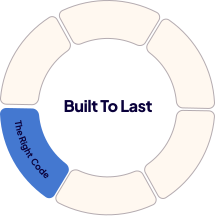
AI code has failure modes that standard software doesn't. Prompts are code. Evaluation frameworks are infrastructure. A prompt that worked in development can behave differently in production as the underlying model updates.
AI writes code faster than ever. It cannot produce the judgment, prompt versioning discipline, or evaluation rigour that keeps an AI system reliable as it evolves.
"We had an existing product and a lot of complexity to work around. EB Pearls helped us improve what was already there without disrupting the business. The process felt structured from day one." — Michael Hanna, Digital Transformation Lead · Bingo Industries
Prompts are version-controlled, documented, and treated as production code. Every prompt change is tracked, tested against the evaluation framework, and approved before deployment.
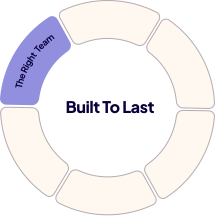
Most AI vendors complete the build and move on. The client is left with a system they don't fully understand, prompts nobody documented, and a model that nobody is watching. When the AI starts degrading — and it will — there's nobody to call.
Structure, accountability, and continuity — so your AI system is genuinely owned, monitored, and maintained for as long as it matters.
"We came to them in a bit of a mess after a previous vendor had delivered something that looked finished but was already causing problems. They helped us untangle what was there, rebuild properly, and get to a place we could actually trust."— Sam Khalef · MYBOS
 "Will it actually work when real users hit it?"
 "Will it hold as usage grows?"
 "Will it still work when the field changes?"


.svg)


Share a few details
Complete the form with your contact details and what you need help with.
Book your free discovery call
Once you submit the form, choose a time that suits you for your discovery call.
Privacy comes first
Sign an optional NDA to ensure the highest privacy level and protection of your idea.
Discovery call
We’ll discuss your goals, the support you need and answer your questions. If we’re a good fit, we’ll outline the next steps.
Share a few details
Complete the form with your contact details and what you need help with.
Book your free discovery call
Once you submit the form, choose a time that suits you for your discovery call.
Privacy comes first
Sign an optional NDA to ensure the highest privacy level and protection of your idea.
Discovery call
We’ll discuss your goals, the support you need and answer your questions. If we’re a good fit, we’ll outline the next steps.