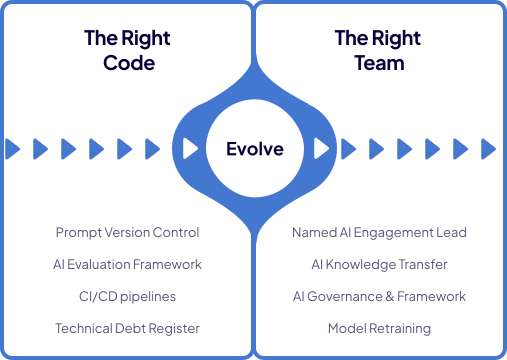
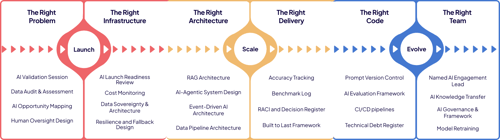
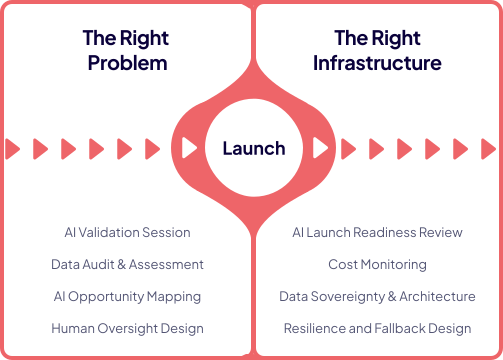
How we take AI from idea to production without the usual mess.

Most AI projects fail commercially, not technically. Here is the exact process we use to prevent that across every stage, from first discovery session to live system.

No pitch. No commitment. NDA before any detailed discussion.

How We Work Together - Regardless of Where You're Starting.

Two things are consistent across every GenAI engagement we run: who owns what, and how we communicate. You'll know both before a dollar is spent.
shield-check

WHAT WE HANDLE

We take end-to-end responsibility for the technical outcome: AI architecture, data pipeline design, model selection and evaluation, accuracy testing, infrastructure, cost monitoring, security, compliance controls, deployment, and post-launch monitoring. Every technical decision is ours to own and defend.
icons-health-insurance

WHAT WE NEED FROM YOU

We need access to the right people and the right data: senior stakeholder availability for milestone sign-offs, business context on the problem, domain expertise for accuracy evaluation, and timely decisions when trade-offs arise. You don't need to understand the AI just your business and your users.

How we communicate throughout the project

One of the most common frustrations teams have is not knowing what’s happening. We prevent that with a consistent communication cadence built into every engagement, so you always know where things stand and what’s next.

The first conversation is about your situation — not our pitch. We want to understand what problem you're actually trying to solve, what data you have, what constraints exist, and whether AI is genuinely the right solution. If it isn't, we'll tell you.

WhoWhat
We Review your use case and flag any obvious risks, gaps, or better alternatives before the session ends
We Run the session with a senior AI strategist — not a sales person
We + You Map your problem, your data landscape, and your definition of success in plain language
You Share context on the business problem, what data exists, and the decision-makers involved

We assess your actual readiness to build AI — not just whether the idea is good, but whether your data, infrastructure, and organisation can support it. Most problems in AI production trace back to decisions that should have been caught here.

WhoWhat
We Audit data quality, accessibility, and volume for each proposed use case
We Assess infrastructure compatibility and identify integration risks before any build commitment
We Map data flows against privacy, compliance, and sovereignty requirements (Australian Privacy Act, GDPR where applicable)
We + You Prioritise use cases by ROI potential, data readiness, and implementation risk
You Provide access to data samples, existing systems documentation, and relevant stakeholders

You'll receive a ranked list of AI use cases with a clear business case for each — ROI estimate, data requirements, implementation risk, and recommended sequencing. No obligation to proceed. No open-ended consultancy. A concrete output you can take to your board.

WhoWhat
We Deliver a prioritised use case roadmap with ROI estimate, data requirements, and risk rating for each
We Provide a realistic cost and timeline range for the highest-priority use case
We Give an honest recommendation on model type, architecture approach, and build-vs-buy decision
We + You Walk through findings together and confirm the right next step — whether that's with us or not

What you walk away with

A production-ready mobile app that's engineered for real-world use: clearly designed, documented, tested, and supported with the operational foundations needed to maintain and improve it over time.

Instead of being left with "something that works", you're left with a product your team can confidently evolve.

"I knew AI was relevant but had no idea where to start or what was actually feasible. The Discovery Session was the most useful hour I'd spent on this topic. They told us which ideas had legs and which to park. No hype. No pitch."

Head of Digital Transformation · Financial Services · Melbourne
Book your free AI Discovery Session

30 minutes. Senior AI strategist. NDA before we discuss your idea. You'll know if AI is right for your situation — and what to build first — before the call ends.

Before any model is selected or any code is written, we design the architecture that the entire system will depend on. For RAG systems, this means vector database selection, embedding pipeline design, and retrieval strategy. For agentic AI, this means agent boundaries, decision rules, and human override logic. Getting this right at week one is what separates AI that lasts from AI that needs rebuilding.

WhoWhat
We Define the end-to-end AI architecture: data ingestion, preprocessing, model layer, retrieval infrastructure, and output handling
We Design data pipelines including anonymisation, tokenisation, and redaction where PII or sensitive data is involved
We Select and justify model architecture (fine-tuned vs. RAG vs. agentic) based on your data, accuracy requirements, and cost constraints
We Design vector databases, embedding pipelines, and retrieval strategies for RAG-based systems
We + You Define accuracy benchmarks, success criteria, and acceptance thresholds before a single model is trained
You Review and sign off on architecture and data flow documentation before development begins

Development happens in two-week sprints with a working demo at the end of every cycle. You always know what's been built, what's next, and what it's costing. Every sprint includes accuracy measurement against the agreed benchmark — not just feature delivery.

WhoWhat
We Build data ingestion pipelines, preprocessing workflows, and embedding pipelines in two-week sprints
We Develop and integrate the AI model layer — whether LLM integration, fine-tuning, RAG, or agentic workflow
We Configure cost monitoring and alerting before any real-world traffic reaches the system
we Build fallback logic, error handling, and human escalation paths into every AI decision point
We + You Review accuracy results and cost metrics at every sprint — not just at launch
You Provide domain expertise for accuracy evaluation and business logic validation at each review

We test against the accuracy benchmarks agreed at the start — not against what the model happens to achieve. We also test fallback behaviour, edge cases, and output boundaries. If the system doesn't meet the pre-agreed standard, it doesn't go live.

WhoWhat
We Evaluate model accuracy against pre-agreed benchmarks across representative real-world query sets
We Test output quality, boundary conditions, hallucination rates, and fallback behaviour
We Run load testing and infrastructure validation to confirm the system performs under production-level traffic
We + You Walk through UAT with your domain experts — the people who will actually use the system day to day
We Provide written sign-off against the pre-agreed accuracy and functionality benchmarks before launch

Deployment is structured, not rushed. We freeze changes, run a readiness review, and confirm that monitoring, alerting, and rollback plans are in place before the first real user arrives.

WhoWhat
We Run a production readiness review: performance, security posture, cost monitoring, and rollback plan
We Configure drift detection and model monitoring to alert before degradation becomes visible to users
We Deploy using CI/CD pipeline with environment parity and release freeze before go-live
We + You Confirm operational readiness: support processes, escalation paths, and internal comms for go-live

Most AI vendors disappear after launch. We don't. Every build includes a 30-day post-launch support window with active monitoring, and we offer ongoing retainers for teams that want continued accountability. The same team that built it stays accountable for it.

WhoWhat
We Monitor model accuracy, output quality, and infrastructure cost in real time — alerting before users notice problems
We Detect and address model drift, data distribution shift, and query pattern changes as they emerge
We Provide full documentation: architecture, data flows, model configurations, and runbooks for your internal team
We + You Monthly model performance reviews and quarterly strategic reviews to surface optimisation opportunities
You Own the deployed system — all code, all pipelines, all model configs — written into every contract

Typical build timeline

AI Discovery Session
1-2 Day
Readiness Assessment
1-2 Weeks
Architecture & Data Design
2-4 Weeks
Model Development
6-16 Weeks
Testing & Validation
3-5 Weeks
Deployment
1-2 Weeks
Post-launch support
30 days min

"We had a clear use case but no idea how to scope it technically. EB Pearls helped us define what 'good' looked like before we started, not after. That single decision changed the outcome of the project."

Product Director · InsurTech · Sydney

Ready to build? Get a free assessment first.

We'll review your use case, flag any architecture or data risks, and give you an honest cost and timeline estimate — before you commit anything.


Most organisations have processes that stay manual simply because automation was never prioritised. We identify the workflows that create the most friction and systemise them.

WhoWhat
We Review current accuracy metrics, cost trends, latency data, and known failure patterns
We Assess the underlying architecture, data pipeline, and model configuration for structural risk
We + You Map the symptoms you're experiencing against likely root causes — model drift, data quality, query patterns, infrastructure, or architecture
We Share access to logs, accuracy metrics, cost dashboards, and any architecture documentation available
You Identify which workflows are highest priority based on business impact and team pain

We deliver a concrete diagnosis with a prioritised remediation plan — what's wrong, why it's wrong, what to fix first, and what it will cost. No open-ended discovery engagements. No solutions recommended before the problem is fully understood.

WhoWhat
We Identify root cause(s) of accuracy degradation, cost escalation, or performance issues
We Deliver a prioritised remediation roadmap: what to fix first, expected impact, and realistic cost estimate
We Recommend whether to rebuild, retrain, optimise, or replace specific components — with honest reasoning for each
We + You Walk through findings and agree on the right next step before any remediation begins

Once the root cause is confirmed, we implement fixes in priority order — starting with whatever is creating the most risk or cost right now. Every fix is tested against the same benchmarks used to define the problem.

WhoWhat
We Implement model retraining, prompt engineering improvements, or RAG pipeline optimisation as indicated by the diagnosis
We Identify and fix query patterns or data pipeline inefficiencies driving cost escalation
We Configure drift detection and monitoring so future degradation is caught before users notice
We + You Review accuracy and cost metrics at each sprint against the pre-agreed stabilisation benchmarks
You Validate accuracy improvements with domain experts before each change is confirmed as resolved

"Our AI was costing three times what we budgeted within six weeks of launch. EB Pearls found the issue — a single inefficient query pattern multiplying across millions of API calls. Costs dropped 40% and the system has been stable ever since."

CTO · Enterprise SaaS · Australia

Book a free AI Audit

Tell us what's wrong. We'll tell you what's actually causing it — and what to do about it — before you spend a dollar on a fix.

Before any automation is designed, we map your highest-volume workflows to understand where AI can take action versus where human judgment is non-negotiable. This is where the governance framework is designed — not retrofitted after launch.

WhoWhat
We + You Map key workflows: input sources, decision points, actions taken, exceptions, and escalation paths
We Identify which workflow steps are candidates for AI automation and which require mandatory human oversight
We Assess data readiness, integration architecture, and compliance requirements for each automation candidate
We Define ROI metrics and tracking methodology before any build commitment
You Identify highest-priority workflows based on volume, cost, and operational pain

We deliver a concrete diagnosis with a prioritised remediation plan — what's wrong, why it's wrong, what to fix first, and what it will cost. No open-ended discovery engagements. No solutions recommended before the problem is fully understood.

WhoWhat
We Identify root cause(s) of accuracy degradation, cost escalation, or performance issues
We Deliver a prioritised remediation roadmap: what to fix first, expected impact, and realistic cost estimate
We Recommend whether to rebuild, retrain, optimise, or replace specific components — with honest reasoning for each
We + You Walk through findings and agree on the right next step before any remediation begins

Once the root cause is confirmed, we implement fixes in priority order — starting with whatever is creating the most risk or cost right now. Every fix is tested against the same benchmarks used to define the problem.

WhoWhat
We Implement model retraining, prompt engineering improvements, or RAG pipeline optimisation as indicated by the diagnosis
We Identify and fix query patterns or data pipeline inefficiencies driving cost escalation
We Configure drift detection and monitoring so future degradation is caught before users notice
We + You Review accuracy and cost metrics at each sprint against the pre-agreed stabilisation benchmarks
You Validate accuracy improvements with domain experts before each change is confirmed as resolved

"We wanted to automate our claims triage but had real concerns about compliance and oversight — this is a heavily regulated environment. EB Pearls designed a system with clear human escalation points and a full audit trail at every critical decision. We cut resolution time by 65% and passed every compliance review."

Head of Operations · EML · Workers Compensation Insurance

Request an Automation Scoping Session

We'll map your highest-impact automation opportunities and give you a realistic picture of what's achievable, what it will cost, and what governance looks like — before you commit.

Still have questions?

A 30-minute conversation will answer most of them. If you're not ready for that, these cover the most common concerns from teams at every stage.

A prototype takes 3–6 weeks. An LLM integration takes 6–10 weeks. A custom GenAI product takes 12–20 weeks. Enterprise agentic AI takes 20–40 weeks. Every project starts with a Discovery Session to scope the work before a timeline is committed.

Yes, with the right architecture. EB Pearls builds data pipelines that anonymise, tokenise, or redact sensitive data before it reaches any third-party model. For clients with strict data sovereignty requirements — government, healthcare, finance, legal — builds use Australian-hosted infrastructure with no third-party data transmission. Data flows are mapped in Week 1.

Every AI system we build has defined fallback logic. For agentic systems, this means human escalation checkpoints at every critical decision point — the agent takes action on clear cases, escalates edge cases, and never acts without an audit trail. The governance framework defines exactly who is accountable for what.

Probably not. Projects range from $30k LLM integrations to $500k+ enterprise AI platforms. The qualifier isn't project size — it's whether the use case is real, whether the data is accessible, and whether you're the right decision-maker to move it forward. If you have a budget of $30k or more and a specific business problem, bring it to a Discovery Session.

You do. 100%. All code, all data pipelines, all model configurations, all documentation — everything created during your project belongs to you on delivery. Written into every contract. You can take it to another team, hand it to an internal developer, or continue with EB Pearls.

We define accuracy benchmarks collaboratively before any model is selected. These benchmarks are business-defined — what accuracy level is required for the system to be genuinely useful in production? — not technically derived. The model isn't selected until we agree on the standard. The system doesn't launch until it meets it.

Yes — the majority of EB Pearls GenAI projects qualify for the Australian R&D Tax Incentive, which can return up to 43.5 cents on every eligible dollar spent. Builds are structured to maximise R&D eligibility from the start. Speak to your accountant or R&D advisor early in the process.
1 Your Information
2 Book Meeting
3 Confirmation

The first conversation costs you nothing.A wrong AI decision costs you everything.

Whether you're exploring a use case, ready to build, or have AI that's underperforming — the first step is a straight conversation. No commitment. No pitch. Just clarity on what's right for your situation.
Contact EB Pearls
What to expect on your call

What to expect

  1. 1 Book a time
    Pick a slot online
  2. 2 NDA signed
    Before any details shared
  3. 3 Real conversation
    Senior AI strategist, 30 min
  4. 4 Honest assessment
    Cost estimate within 48 hours

What to expect

  1. 1 Book a time
    Pick a slot online
  2. 2 NDA signed
    Before any details shared
  3. 3 Real conversation
    Senior AI strategist, 30 min
  4. 4 Honest assessment
    Cost estimate within 48 hours