

40K+
Active users — Plenti, no rebuild required
"Software isn't finished when it launches. It's finished when the business no longer needs to think about it."
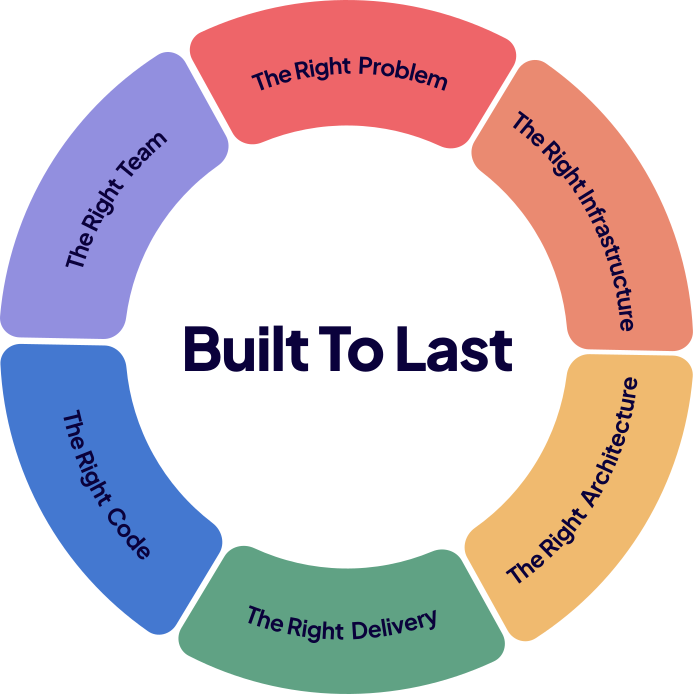
Most software agencies measure success at launch. We measure it differently. Built to Last™ is the framework we apply to every EB Pearls project — not as a premium tier, not as an optional upgrade. As the standard. Because we've seen what happens when these foundations are missing, and we've spent 20 years learning what it takes to build software that genuinely lasts.
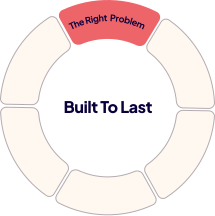
The industry has a structural incentive problem. Vendors underquote to win work, skip discovery to start billing sooner, and agree to scopes they know will change. The result is projects that go over budget, get abandoned mid-build, or are quietly shelved six months after going live because nobody asked the right questions at the start.
Before a wireframe is drawn or a line of code is written, the Discovery Workshop maps exactly what is being built, why, for whom, and what success looks like. Not a sales call — a working session with your decision-makers that produces a locked scope document.
⚠ You're missing this if:
"The Discovery phase saved us from making expensive mistakes we didn't even realise were there. It challenged our early assumptions, clarified what needed to be built first, and gave us a much stronger foundation before development started."
— Laura Smith · News Corp Australia
A structured 2–3 day engagement that defines exactly what is being built, who it's for, what the success metrics are, and what the minimum viable scope is before development begins.
What is the single assumption your product depends on that hasn't been validated by real users yet? The cheapest validation is always before development, not after launch.
What is in the MVP and — equally important — what is explicitly out. The features that aren't in the MVP are not forgotten — they're documented in the roadmap with the reasoning.
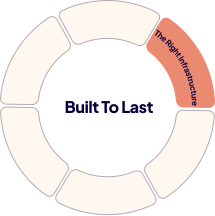
An MVP built on infrastructure that can't scale is not actually cheaper — it's a deposit on a future rebuild. The architecture decisions made to ship quickly compound into the technical debt that makes every subsequent feature cost twice as much and take twice as long.
Production-grade is the starting assumption, not the premium upgrade. The infrastructure that supports your MVP needs to be the same infrastructure that survives your Series A due diligence and your first 10,000 users — because the rebuild you'd otherwise need is far more expensive than getting it right the first time.
"The MVP exceeded expectations — EB Pearls' quality work allowed us to secure Series A funding. The investors who reviewed the codebase came back with no material findings."
— Gerhard Stander · Founder · Caroo App
Hosting architecture, environment separation, CI/CD pipeline, monitoring and alerting, backup procedures, and security configuration all reviewed before go-live. The review that surfaces problems when they're cheap to fix.
Infrastructure built to survive technical due diligence — documented, reproducible via IaC, with security controls that holds up to a professional review. The cost of addressing them at sprint 1 is a fraction.
Load tested before launch, not after the first traffic spike. What does the product do at 10× current users? Documented and tested before a single press mention. The performance benchmark that decides whether it's an opportunity or incident.
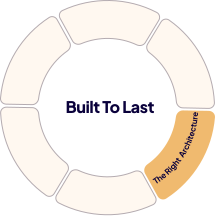
Architecture decisions made at the start of a product build determine the cost of every feature that follows. A monolith that made sense for an MVP becomes the bottleneck at scale. A microservices architecture chosen for a ten-person startup creates operational complexity that kills velocity. The right architecture is right for the stage of the business — not the architecture the developer is most comfortable with.
Technology stack chosen for the product and its trajectory. Every significant architectural decision documented with reasoning — so when you hire your third developer, they understand not just what was built but why.
"Since launch, the app has had over 7,000 downloads, with around 6,000 users completing signup in the first 6 weeks. The architecture held under demand we didn't predict."
— Giuseppe Saffioti · Co-Founder · Intro Dating App
Every architecture decision tested against three questions: does it work for what you're building now, does it hold at 10× the current load, and does it survive a major pivot in product direction without a full rebuild?
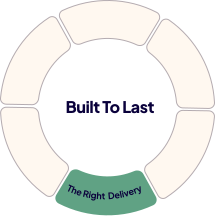
Most software delivery failures aren't engineering failures. They're accountability failures. No written record of what was agreed. Milestone payments released against time rather than delivered software. Scope changes absorbed verbally with no paper trail. A client who finds out what was built at handover rather than at every sprint.
Working software demonstrated at the end of every sprint. Milestone payments tied to approved software, not to time spent. Every scope change written down, costed, and approved before the work starts.
"Approachable and accommodating to our exact needs. Very professional, always on track, and always delivered to our expectations. The milestone structure meant we always knew what we were paying for."
— Roberto Peresa · Founder · Aguzzo Group
Payments tied to delivered and approved software at each milestone. A vendor who only gets paid when software is approved is very different than a time-and-materials arrangement.
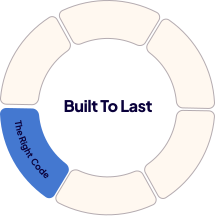
An MVP that ships fast and is immediately unmaintainable isn't actually faster — it's more expensive. Every feature added to a poorly structured codebase costs more than the last. Technical debt that accumulates silently in development shows up loudly in investor due diligence, in engineer onboarding time, and in the cost of every subsequent sprint.
Code that any competent engineer can inherit, test, and extend. Documentation written during development — not assembled retrospectively when someone is leaving. Test coverage that holds under product changes, not just under the original spec.
"Extremely impressed with EB Pearls' technical skill and ability to adapt. High attention to detail — a wonderful experience. When we needed to scale the team, the codebase was clean enough for new engineers to onboard in days."
— Sarah Scaife · Product Owner · BAXTA
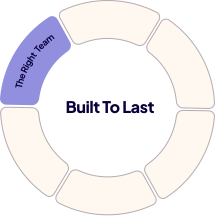
Most agency failures happen at the team level. Rotating contractors who've never seen the full codebase. A project manager who relays messages between the client and developers who've never spoken to each other. A team that ships and disappears, leaving behind a system nobody can maintain.
The same dedicated team from Discovery Workshop to post-launch handover. One named product lead who knows the codebase, the client's business, and the decisions that shaped both. Post-launch accountability agreed before the build begins — not negotiated after the first incident.
"They explained every decision clearly and gave honest advice. I never felt overwhelmed, and I always knew exactly who was accountable. That combination is rarer than it should be."
— Chris Richardson · Founder · Beforepay
 "Will it hold when real users arrive?"
 "Will the architecture hold as we grow?"
 "Can it handle compliance, legacy systems, and real organisational complexity?"


Share a few details
Complete the form with your contact details and what you need help with.
Book your free discovery call
Once you submit the form, choose a time that suits you for your discovery call.
Privacy comes first
Sign an optional NDA to ensure the highest privacy level and protection of your idea.
Discovery call
We’ll discuss your goals, the support you need and answer your questions. If we’re a good fit, we’ll outline the next steps.
Share a few details
Complete the form with your contact details and what you need help with.
Book your free discovery call
Once you submit the form, choose a time that suits you for your discovery call.
Privacy comes first
Sign an optional NDA to ensure the highest privacy level and protection of your idea.
Discovery call
We’ll discuss your goals, the support you need and answer your questions. If we’re a good fit, we’ll outline the next steps.