
150%
Engagement uplift · Vodafone Fiji
"Software isn't finished when it launches. It's finished when the business no longer needs to think about it."
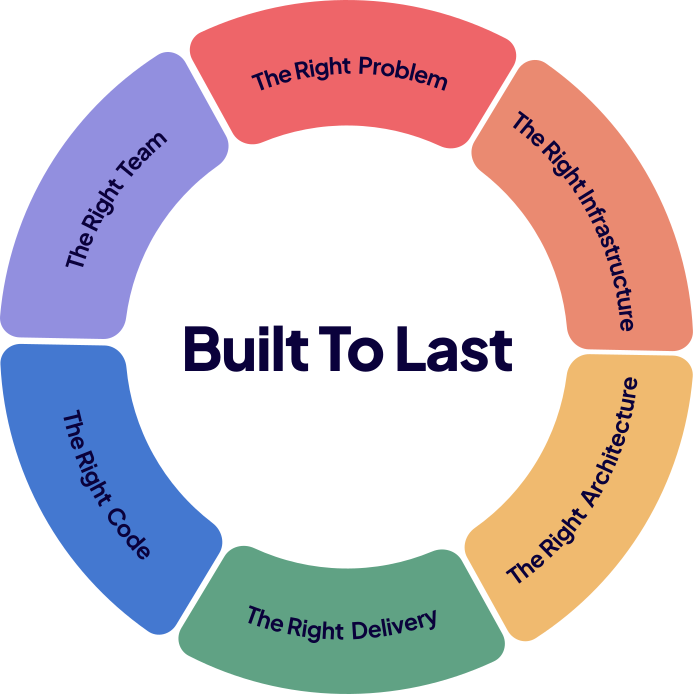
Most software agencies measure success at launch. We measure it differently. Built to Last™ is the framework we apply to every EB Pearls project — not as a premium tier, not as an optional upgrade. As the standard. Because we've seen what happens when these foundations are missing, and we've spent 20 years learning what it takes to build software that genuinely lasts.
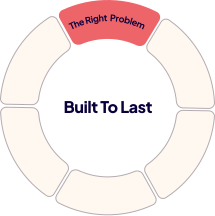
The most expensive mistake in software isn't technical. It's six months of excellent work delivered to the wrong outcome.
Before a line of code is written, we map the real problem. Not as described in the brief. The one that actually exists in your business.
⚠ You're missing this if:
"The Discovery phase saved us from making expensive mistakes that we didn't even realise were there. It challenged some of our early assumptions, clarified what actually needed to be built first, and gave us a much stronger foundation before development started." — Laura Smith · News Corp Australia
A structured session with your key stakeholders. A deliberate interrogation of the real problem: its root cause, its cost, and what a successful solution would produce.
Five questions every project must answer before code is written. Building the wrong thing confidently is the most expensive mistake in software.
A structured audit identifying where AI creates genuine business value in your product — before architecture is locked, not retrofitted after launch.
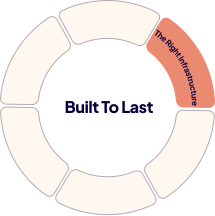
A product that performs in testing and fails under real users. Infrastructure isn't a launch concern. It's what determines whether your product holds up at 10x.Designed in from the start. Maintained throughout. Not bolted on at the end.
⚠ You're missing this if:"What impressed us most was that the support did not stop at launch. When issues came up, they were responsive, clear, and easy to work with. It felt like we had a partner behind the product, not a team that disappeared after the initial job was done." — Matthew Baker · EML
Infrastructure health, security posture, monitoring coverage, rollback procedures, and escalation paths. All validated before a single user hits the live system.
Production-grade cloud infrastructure from day one. Separated environments, infrastructure-as-code, and a cost model that scales.
Risk register, disaster recovery planning, simulation, error tracking, and alerting built in before your first user arrives.
Circuit breakers, retry logic, and health checks so the system degrades gracefully when something goes wrong.
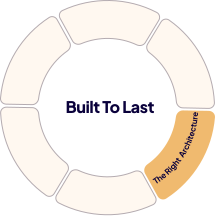
Architecture is invisible when it's right. A "simple" feature request that requires touching half the codebase — that's architecture done wrong, compounding with every sprint.
Every architecture decision made deliberately, before development begins. Not discovered as a conflict 14 months into a build.
⚠ You're missing this if:"As usage grew, our app kept up. We didn't hit a wall of slower releases, unstable features, and constant firefighting. The foundations were strong from the start, and that gave us confidence as the business grew. It was one less thing to think about." — Shimneet Chand · Vodafone Fiji
Every architecture decision tested against three horizons: today's build, 10x scale, and AI readiness in three years. No decision made blind.
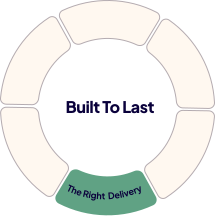
Scope creep doesn't arrive as a sudden crisis. It arrives as a series of small, reasonable-sounding conversations that nobody wrote down.
The best technical work fails if the people aren't aligned, informed, and accountable. Scrum as a genuine discipline, not a label. A document layer that keeps leadership in control.
⚠ You're missing this if:"One of the biggest differences was visibility. We always knew what was happening, what decisions were needed, and what was coming next. We were never left chasing updates or wondering where things stood." — Kym Herbert · Optus
Who owns every decision is clearly defined and documented from day one. When decisions are questioned later, the answer is recorded and traceable.
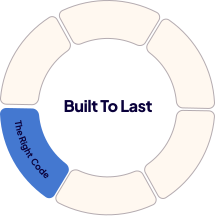
Engineering quality is invisible when it's present. Catastrophically visible when it's missing. The deterioration follows a predictable pattern — and ends in a rebuild conversation that costs years.
AI writes code faster than ever. It cannot produce judgment, standards, or the discipline to write code the next engineer can trust.
⚠ You're missing this if:"We were not starting from scratch. We had an existing product, internal stakeholders, and a lot of complexity to work around. EB Pearls helped us improve what was already there without disrupting the business. The process felt structured from day one." — Michael Hanna, Bingo Industries
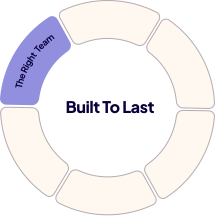
When you trace most software failures back to their root cause, you find a people problem. Knowledge that walked out the door. A handover that never really happened.
Structure, accountability, and continuity so your product is genuinely owned, without single points of failure, for as long as it matters.
⚠ You're missing this if:"We came to them in a bit of a mess after a previous agency had delivered something that looked finished but was already causing problems. They helped us untangle what was there, rebuild the foundations properly, and get the product to a place we could actually trust." — Sam Khalef · MyBos
 "Will it actually work when real users hit it?"
 "Will it hold as we grow?"
 "Will it still work when our world changes?"


Share a few details
Complete the form with your contact details and what you need help with.
Book your free discovery call
Once you submit the form, choose a time that suits you for your discovery call.
Privacy comes first
Sign an optional NDA to ensure the highest privacy level and protection of your idea.
Discovery call
We’ll discuss your goals, the support you need and answer your questions. If we’re a good fit, we’ll outline the next steps.
Share a few details
Complete the form with your contact details and what you need help with.
Book your free discovery call
Once you submit the form, choose a time that suits you for your discovery call.
Privacy comes first
Sign an optional NDA to ensure the highest privacy level and protection of your idea.
Discovery call
We’ll discuss your goals, the support you need and answer your questions. If we’re a good fit, we’ll outline the next steps.