
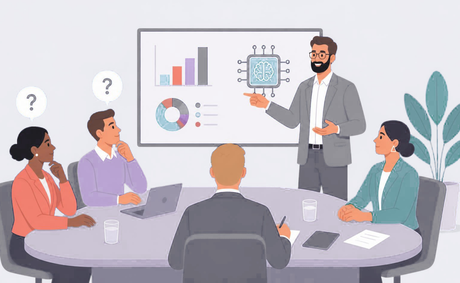
6 AI Questions Your Board Will Ask, and How to Answer Them

6 AI Questions Your Board Will Ask, and How to Answer Them
Published

08 Oct 2026

Author
Binisha Sharma

Binisha Sharma

6 AI Questions Your Board Will Ask, and How to Answer Them
4:51
 
Table of Contents

An AI proposal gets one reading at board level, and directors ask about the downside before the upside. They aren't testing whether you understand the technology; they're testing whether you've thought like an owner. Here are the six questions to answer before the paper goes in, and what a strong answer to each sounds like.

lightbulb-filament

Why we wrote this

When executives talk to us about AI, the hard part is rarely the build. It's the paper that has to get it funded. We see sound proposals stall because they explain what the AI does, and not who owns it, what it costs to keep or how it would end.

That gap matters more now that directors have their own published guidance on what to ask. This is for the executive whose name sits beside the initiative, not the team writing the technical spec. It won't rescue a weak idea, but it should help a sound one get a clear decision.


The paper due on Friday

The board pack closes on Friday. This quarter it carries a new line: an AI initiative, with your name beside it.

The proposal looks sound. The vendor demo went well, and your team is keen. The numbers came out of a workshop, and everyone in the room liked them.
 
Then you picture the meeting. A director who chaired an audit committee for a decade turns to page four. She doesn't ask what the model does; she asks what happens if it's wrong.
 

The short answer: Boards treat AI like any other capital decision. Expect six questions: what it will return, what could go wrong, who is accountable, what it costs to run, why now, and how you would stop it. A paper that answers all six plainly gets a decision, not a deferral.

Why AI papers come back from the board

Most AI business cases are written to win approval. They lead with the upside, and the question a careful director asks first gets one sentence near the end.

In our experience, boards rarely reject AI papers for being risky. They defer them for being unanswerable. The paper that explains how the initiative would stop is often the easiest to approve, because the downside is capped.
 
Directors are being told to look for exactly this, and the corporate regulator, ASIC, has warned of the potential for governance to lag AI adoption. The Australian Institute of Company Directors' updated Director's Guide to AI Governance asks whether boards have "agreed measures and indicators of AI progress and ultimate success, including return on investment". It also notes that where risks originate with vendors, "accountability remains with the organisation."
 
Here's the honest part. Some answers can't be firm before a pilot. Return and running cost often only become reliable once the system has run on your own data.
 

A good paper says so, and says when the numbers will firm up. Directors trust a stated unknown more than a confident guess.

The six AI questions for the board

Each question has a reason behind it. The weak answers are common. The strong ones are short, specific and owned.

1. What will it return?

The board wants value it can measure. The AICD guide warns against "AI for AI's sake". 

  • What it looks like: "Significant productivity gains across the business."
  • What good looks like: one process, one baseline, one measure. An illustrative example: claims triage takes four days today, and the pilot targets one.

2. What could go wrong?

Directors weigh downside against risk appetite. They expect risks named, not managed out of sight. 

  • What it looks like: "Risks are minimal. The vendor has strong security."
  • What good looks like: the three most likely failures, how you would notice each, and what each would cost.

3. Who is accountable?

The board wants one name. In the HTI survey behind the AICD guide, leaders named several roles as primarily responsible: the CEO (52.9%), technology chiefs (46.1%) and the board (21.8%). Responsibility spread that widely is how nobody ends up owning it.

  • What it looks like: "IT owns it," or "the vendor manages the model."
  • What good looks like: a named executive owns the outcome. A named person approves anything that reaches a customer, regulator or bank account.

4. What does it cost to run?

The build cost is visible. Running cost is where AI surprises.

  • What it looks like: the build quote, and nothing after go-live.
  • What good looks like: a year-one and year-two view of usage, model fees, support and staff review time, with what moves each.

5. Why now?

The board wants the cost of waiting, and evidence the organisation is ready.

  • What it looks like: "Our competitors are doing it."
  • What good looks like: a specific trigger, such as a backlog that grows every quarter or a contract renewal, plus a decision date.

6. How would we stop it?

This is the question most papers skip. Directors want to know the exit is cheap. 

  • What it looks like: no answer, or "we won't need to."
  • What good looks like: stop criteria agreed up front, a fixed-scope first phase, data and code you own, and the old process still able to run.

When it isn't ready for the board

If you can't answer question one yet, don't take a full rollout to the board. Take something smaller.


If no process has a clear baseline at all, AI may not be the next investment. That's a respectable thing to tell a board.


What a credible accountability answer rests on

Question three is where most papers are thinnest. A credible answer rests on three things a director can check: narrow permissions, a human gate and a record.

We build software with AI agents, so our own answer faces the same test. In our Agentic Development Life Cycle, agents plan, build, test and prepare deployment, each with one job and narrow permissions. The planner can't commit code; the builder can't push to main.

Senior engineers own architecture and review every pull request. Coding standards and a full audit trail keep every step traceable.
 
The rule is simple. "Every pull request is reviewed and merged by a senior EB Pearls engineer. Nothing reaches production without human approval."
 
 
Longevity matters too, because AI systems need owning for years. We've kept 97% of our clients through 22 years of evolution from web to mobile to AI-native. That's a track record, not a promise.
 

What drives the running cost

Four drivers move it most.

icon-devops

Usage

How many documents, transactions or queries the system handles each month.
icons-cash-bag

Model costs

Provider fees rise with volume and with the size of each request.
product and account support

Support

Monitoring, fixes and updates as data, models and rules change.
timer

Review time

Staff hours spent checking outputs. Regulated work needs more, and most papers leave it out.

If governance is new to your organisation, the National AI Centre's Guidance for AI Adoption recommends an AI policy and an AI register. 

How we approach it

icons-salesforce

NEXUS Foundation

The board paper is a deliverable, not an afterthought. Foundation is one fixed-scope 8-week proof of concept, ending in a Stakeholder Investment Case.

That case is built around these six questions. It uses results from a Working AI Solution on your own data, not workshop estimates. A Production Roadmap sits beside it, so the board sees the next phase and where it could stop.
 

Check your paper before Friday

  1. Could you answer each of the six questions in one paragraph today?
  2. Does one named person own the outcome?
  3. Have you written down what would make you stop?


Frequently Asked Questions

How do we present AI risk to a board without alarming it?

Name each risk, how you would detect it and what you would do. Three specific risks with controls read as competence. A vague assurance that risks are minimal reads as the opposite.

What is a realistic timeframe for AI return?

Tie it to one measure on one process. A fixed-scope pilot should show within weeks whether that measure moved. Wider returns follow once people use the solution in production.

Who should present the AI paper to the board?

The executive who will own the outcome. A technical lead can join for questions. If a vendor presents, directors will rightly ask who inside the business is accountable.

What should an AI business case include?

One process, its baseline and the measure you expect to move. Add the main risks, a named owner, a two-year running cost, the reason to act now and the conditions for stopping. If it can't answer those plainly, it isn't ready for the board.

What does AI governance mean for a board?

It means the board knows where AI is used, who owns each use and how each is checked. Directors don't need to understand the model. They need named accountability, agreed measures and a record of decisions they can review.

How do you measure AI ROI?

Measure one process against its baseline, before and after. Count the time, cost or errors that moved, then subtract running costs, including staff time spent checking outputs. A return that exists only in a workshop estimate isn't a return yet.

How long should an AI pilot run before the board decides?

Long enough to run on your own data, and short enough to keep a fixed decision date. Set the length, the measure and the stop criteria before it starts. An open-ended pilot rarely produces a decision.

What drives the cost of an AI initiative?

Running cost is driven by usage, model fees, support and staff review time. Build cost depends on how many systems it connects to, the state of the data and how regulated the work is. Regulated work needs more human review, and most estimates leave that out.

Should a board approve AI if the numbers aren't firm yet?

Yes, if what it approves is small and capped. Approve a fixed-scope pilot with a decision date, not a full rollout. The pilot's job is to turn estimates into numbers the board can trust.


Want a second opinion before you decide?

Book a free 30-minute Fit Call. Whether it’s an AI idea, a new build or a system that’s slowing down, we’ll tell you what’s worth doing, what we’d drop, and whether we’re the right fit at all. No commitment. No pitch deck.