
0
Hours unplanned downtime — 20+ migrations
"Software isn't finished when it launches. It's finished when the business no longer needs to think about it."
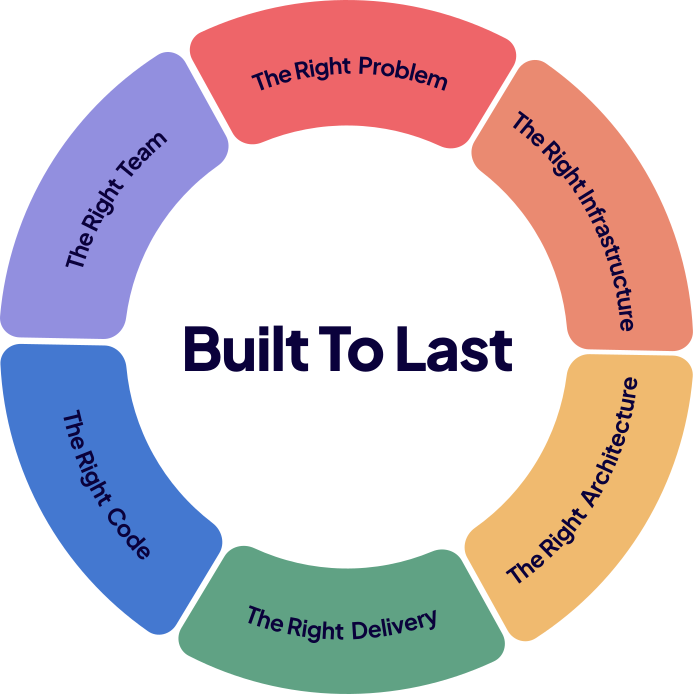
Most software agencies measure success at launch. We measure it differently. Built to Last™ is the framework we apply to every EB Pearls project — not as a premium tier, not as an optional upgrade. As the standard. Because we've seen what happens when these foundations are missing, and we've spent 20 years learning what it takes to build software that genuinely lasts.
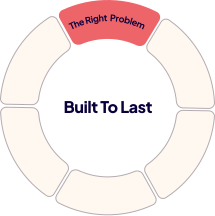
The most expensive DevOps engagements are the ones that started without discovery. Jumping straight to solutions — new CI/CD tooling, a Kubernetes migration, a cloud provider switch — without mapping the current state creates new problems layered on top of old ones.
Before a single resource is provisioned or a pipeline is modified, we run the Cloud Audit. A structured assessment of your current infrastructure, deployment process, security posture, and cloud costs. We find the pain before we prescribe the solution — and we never recommend more than what you need.
⚠ You're missing this if:
"No black holes. No guesswork. They mapped what we had, told us what actually needed to change, and didn't recommend anything we didn't need. That honesty was what won us over."
— Engineering Lead · FinTech · Sydney
A structured 1–2 week assessment of your current infrastructure — architecture, deployment pipelines, security posture, IAM configuration, cost breakdown, and compliance gaps. An honest map of what's working, what's fragile, and what needs to change. The output is a written assessment you can act on with any provider.
A structured analysis of your current cloud spend — by service, environment, and team. Identifies waste (idle resources, oversized instances, untagged spend), surfaces the cost drivers that compound silently, and produces a prioritised optimisation list before anything is built. Average 38% cost reduction identified in first pass.
IAM configuration, exposed services, unencrypted data stores, missing MFA, overpermissioned roles, and compliance gaps — assessed before a recommendation is made. Security problems found during audit cost nothing to fix relative to security problems found in a compliance review or after a breach.
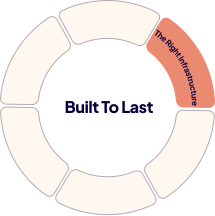
Infrastructure built without Infrastructure as Code creates a permanent dependency on the team that built it. When engineers leave, the system becomes unmaintainable. When something breaks at 2am, nobody can trace what changed. When you want to replicate the environment, it's months of work instead of a single command.
Everything in Terraform. No snowflake servers. No console-only modifications. Every resource version-controlled, reviewed, and reproducible from day one.
"We had a major data centre migration with a hard deadline. EB Pearls built the plan, executed it flawlessly, and left us with infrastructure we actually understand and can modify ourselves."
— CIO · Logistics Enterprise · Brisbane
A structured review that designs cost controls into the infrastructure — resource tagging taxonomy, budget alerts by team and environment, right-sizing analysis, reserved instance strategy, and auto-scaling policies. Cloud costs that spiral undetected because FinOps was treated as a post-launch concern.
Every resource defined in Terraform or Pulumi — version-controlled, peer-reviewed, and applied through CI/CD. No manual console modifications, ever. The IaC standard is what makes infrastructure auditable, reproducible, and inheritable by any engineer — not just the one who built it. Terraform state stored remotely.
A consistent tagging strategy applied to every cloud resource from day one — environment, team, service, cost centre. Without tags, cloud cost attribution is archaeology. With them, you can answer "how much does the payments service cost to run?" in under 30 seconds. Enforced via IaC policy, not documentation.
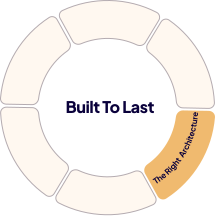
Architecture decisions compound. A Kubernetes cluster chosen for the wrong reasons, a monolith containerised without decomposition, a region chosen without considering data sovereignty — each creates a constraint that becomes exponentially more expensive to change under load.
Target architecture designed and approved before a single resource is provisioned. Not discovered as a conflict six months into production.
"Our deployment frequency went from once a fortnight to multiple times a day. The architecture they designed held — no incidents, no emergency rollbacks. That confidence changed how we work."
— VP Engineering · Series B Lending Platform
Kubernetes is the right answer for some workloads and significant overhead for others. We make the recommendation deliberately — when Kubernetes is warranted versus when ECS or a serverless approach achieves the same outcome with less operational burden.
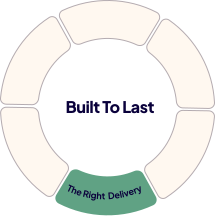
Big-bang migrations and big-bang pipeline rollouts share the same failure mode: too many changes at once, no clean rollback path, and a team under deadline pressure making decisions they wouldn't otherwise make. The sequencing matters more than the individual steps.
Phased delivery with parallel run periods, proven rollback procedures, and monitoring live before the first workload goes live. No surprises. No emergency change windows at 11pm.
"We had 14 applications to migrate with a hard 90-day deadline and a HIPAA audit in month four. Phased execution, parallel runs, zero downtime. Two days early."
— CIO · ASX-Listed Healthcare Provider
Workloads sequenced by risk, dependency, and business criticality — lowest risk first, most critical last. Parallel run periods with live traffic split before full cutover. Rollback procedure written, tested, and ready before any workload moves.
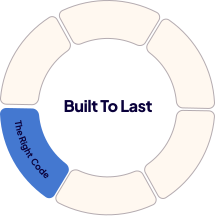
Security bolted on after launch costs 10× more to fix than security built in from sprint one. SAST, DAST, and dependency scanning retrofitted into an existing pipeline are always incomplete — gaps exist wherever the retrofit didn't reach. IAM permissions granted as "temporary" that became permanent. Secrets committed to Git that can't be rotated.
Security gates in the CI/CD pipeline from the first sprint. Observability configured before the first user arrives. IAM least-privilege from environment one. Not a compliance checkbox — the standard every pipeline runs to.
⚠ You're missing this if:
"Security was in the pipeline before the first sprint ended. SAST, dependency scanning, IAM review — all automated. Our compliance audit passed with zero findings. That's not luck."
— CTO · ASX-Listed Healthcare Provider
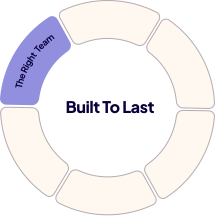
Most DevOps consultants complete the engagement and move on, leaving behind a system only they fully understand. When something breaks at 2am six months later, there's nobody to call who knows the context. When the next engineer tries to modify the infrastructure, they start from archaeology.
Our goal is your independence. Every engagement ends with a team that can operate, modify, and evolve the infrastructure without us — and runbooks that make 2am incidents navigable by whoever is on call.
"When the engagement ended, we had the runbooks, the architecture docs, the Terraform, and a team that had been trained to operate it. We didn't need to call them back. That was the point."
— VP Engineering · Series B Lending Platform
Confident go-live — not crossed fingers
 "Will it hold when real traffic hits it?"
 "Will it hold as the product and team grow?"
 "Can our team evolve this without you?"


If you think we might be a fit, let's find out. A 30-minute discovery call. No pitch deck. No obligation. Just an honest conversation about what you're building and whether we're genuinely the right fit.