
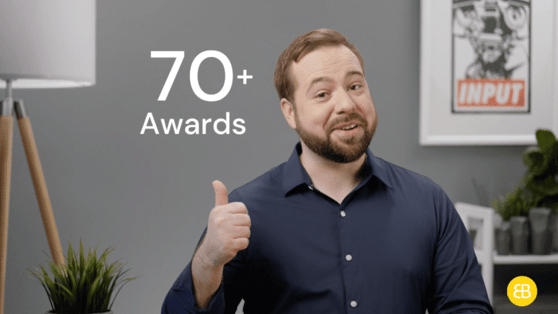
+340%
Online donation revenue — Heart Research Australia
"Software isn't finished when it launches. It's finished when the business no longer needs to think about it."
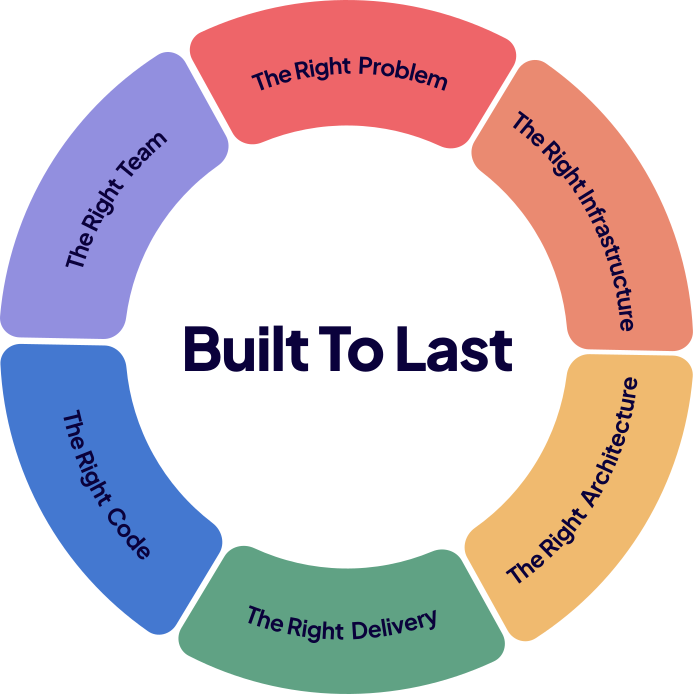
Most software agencies measure success at launch. We measure it differently. Built to Last™ is the framework we apply to every EB Pearls project — not as a premium tier, not as an optional upgrade. As the standard. Because we've seen what happens when these foundations are missing, and we've spent 20 years learning what it takes to build software that genuinely lasts.
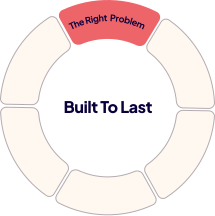
The most expensive mistake in web development isn't technical. It's choosing the wrong platform, defining the wrong success metric, or starting design before the business objective is clear. Most web projects are scoped around outputs — pages, features, hours — rather than outcomes.
Before a wireframe is drawn, we run the Strategy Session. Not a sales call. A structured conversation about your business, your buyers, your competitors, and what your website actually needs to do to earn its keep.
⚠ You're missing this if:
"EB Pearls were the first agency that came with a strategy before a quote. The WordPress build took our leads from 4 a month to 40." — Director · Law Firm · Melbourne
A structured 60-minute session before any scope, design, or platform decision. We map your business objective, your buyers, your competitors' positions in Google, and what the site needs to do commercially.
WordPress, Shopify, WooCommerce, headless — evaluated against your business, not our margin. The wrong platform costs 2–3× the original build to fix. We give a written recommendation with reasoning.
Who ranks for the queries your buyers use — and why. Gap analysis between your current site and the top three competitors. The keyword strategy that informs URL structure, page templates, and content priorities.
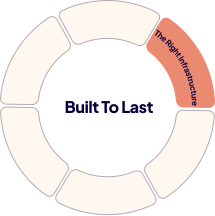
A beautiful website on slow hosting is an expensive mistake. Page load time directly affects Google rankings and conversion rates — a one-second delay in load time reduces conversions by 7%. Infrastructure decisions made at the start of a project determine what's possible for the life of the site.
CDN, caching, hosting architecture, uptime monitoring — configured before launch, not diagnosed after the first traffic spike.
"After the rebuild, our page load dropped from 9.4 seconds to 2.1 seconds. Google Rankings started moving within six weeks — and our team can now manage everything without a developer call."
— Marketing Manager · Heart Research Australia
A structured pre-launch review covering hosting performance, CDN configuration, SSL and security headers, uptime monitoring, backup procedures, and Core Web Vitals. We don't launch with a site that loads in 6 seconds on mobile.
Hosting selected for the site's actual requirements — traffic volume, geographic audience, eCommerce transaction volume, uptime SLA. CDN configured from launch so assets are served from edge nodes close to your users.
SSL, security headers, WAF configuration, and OWASP-aligned hardening. For eCommerce: PCI-DSS awareness, checkout security, and Australian Privacy Act compliance baked in.
Information architecture and URL structure are the most commonly underinvested decisions in web development. A URL structure that made sense at launch becomes impossible to expand. A CMS built for the developer rather than the marketing team creates a dependency that costs $300 per content change.
Architecture designed for the people who will use it — the marketing team updating content, the SEO manager adding landing pages, the developer adding a new product category three years after launch.
"We came in with the idea and no technical background. EB Pearls explained every decision clearly, gave honest platform advice, and built a CMS our marketing team can manage without developer calls."
— Chris Richardson · Founder · Beforepay
URL structure designed for search — logical hierarchy, keyword-informed slugs, category and subcategory structure that supports expansion, canonical tag strategy. The URL decisions made at launch are the most expensive to change later. We make them documented.
Web projects fail in delivery when design starts before strategy, development starts before design is approved, and launch happens before QA is complete. The sequence matters more than the individual steps.
Every milestone signed off before the next begins. Staging site access throughout. Working pages demonstrated at the end of every sprint — not a status update about what was built.
⚠ You're missing this if:
"Every edge case had been considered, tested, and handled. Weekly sprints, live demos, transparent updates — we always knew exactly where things stood."
— Andrew Penn, Board Advisor · CryptoNest · Melbourne
Every page template designed around conversion architecture — above-the-fold content, trust signal placement, CTA hierarchy, friction reduction in forms and checkout. Pretty and effective are not the same thing. We optimise for the metric that matters: phone calls and form submissions.
Technical SEO is not a bolt-on. Schema markup, canonical tags, XML sitemaps, and structured data — added after launch are less effective and more expensive than built in from the first template. Every page EB Pearls builds is built with Google in mind from line one of code.
The code that powers your website determines your Google rankings, your accessibility compliance, and whether the next developer who touches it can work efficiently or has to start over.
"From the very first meeting, EB Pearls gave us a clear roadmap, a complete technical audit, and clean documentation. For the first time we had real confidence in our platform." — Bishal Dahal · ActivfyApp · TitanTech Support
Image CDN, next-gen format delivery (WebP/AVIF), code splitting, critical CSS inlining, and third-party script management. A one-second improvement in load time increases conversions by up to 7%.
Most agencies complete the build, hand over credentials, and move on. The client is left with a site nobody knows how to update, no analytics baseline to measure against, and no idea why traffic dropped three months after launch.
The 90-day post-launch window isn't a support contract. It's the period when the site gets better — conversion improvements, SEO adjustments, analytics reviews, and iterative fixes. Included in every project. Not negotiable.
"EB Pearls were responsive, clear, and easy to work with long after launch. It felt like we had a partner behind the product — not a team that had moved on to the next client."
— Sam Khalef · MYBOS
 "Will it rank on Google and convert when it goes live?"
 "Will it keep performing as the business grows?"
 "Can we rebuild without losing our Google rankings?"