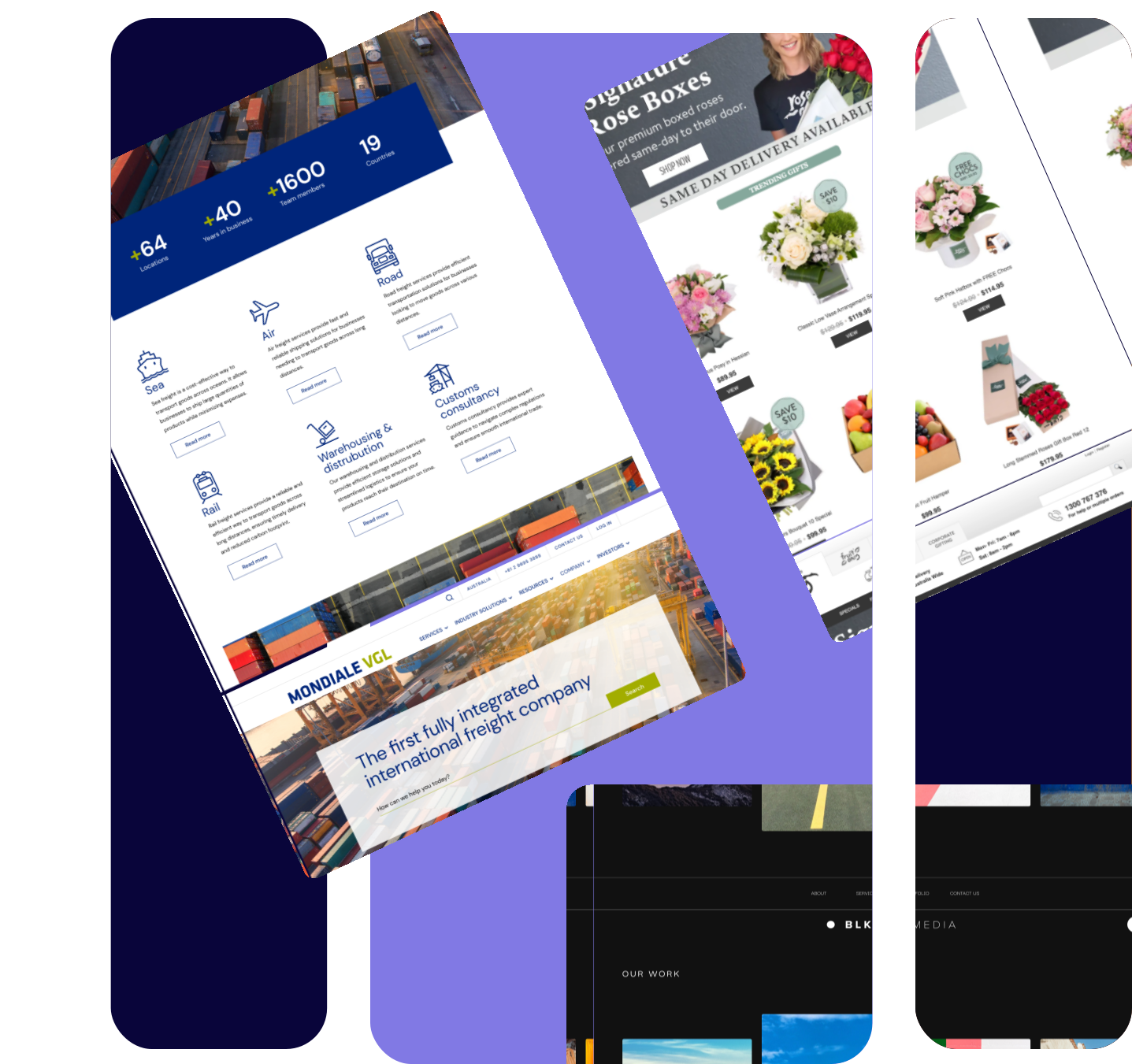
Content managed by editors,delivered by a React frontend that performs.

We design content models and build headless CMS implementations on Contentful, Sanity, and Strapi with Next.js fronted by a CDN. One content repository; delivered to web, mobile app, and any channel via API.
Tech_Headless CMS-1
icon-recruitment3
50+
Headless implementations delivered
icons-complex-workflow-2
Next.js
Frontend standard
icons8-medal-1-2
Contentful · Sanity · Strapi
All in production
icon-trophy
#1
Clutch

Headless CMS platforms we implement

Four platforms — each suited to different team sizes, content complexity, and budget requirements. We recommend based on your situation.
01

Contentful

Enterprise structured content platform. Strong content modelling, localisation support, polished editor experience. Best for large teams and enterprise governance. Plan for Contentful pricing at scal, we help model content efficiently to control costs.

02

Sanity

Highly customisable headless CMS with a programmable Studio built in React. Excellent for complex content models with custom field types and real-time collaboration. GROQ query language is powerful. Can be self-hosted.

03

Strapi

Open-source, self-hosted headless CMS. Full control over hosting and data. REST and GraphQL APIs. Best for teams with data sovereignty requirements, tight budgets, or who want to avoid SaaS licensing costs.

04

Headless WordPress (WPGraphQL)

WordPress as content backend, Next.js as frontend. Best for organisations with existing WordPress content investment and editors comfortable with WordPress admin UX.

05

Multi-Channel Content Delivery

One content model delivered to web, iOS, Android, and any third-party channel via API. Content team manages content once. Every channel stays in sync.

06

Content Model Design

We spend significant time on content modelling before any development begins. Getting the content types, fields, and relationships right upfront is significantly cheaper than rebuilding after launch.

Who hires us

icons8-lightning-bolt

Marketing teams frustrated by slow, developer-dependent CMS updates

Publishing a blog post requires raising a ticket. Your WordPress theme is slow. A headless CMS with a custom Sanity Studio gives your team true independence and your visitors the performance they expect.
globe

Product teams delivering content to multiple channels

Website, mobile app, email, and third-party integrations all need the same content. Managing it in five places creates inconsistency. A headless CMS is the single source of truth that all channels pull from.
magnifying-glass-1

SEO-driven businesses losing traffic to slow page loads

Google's Core Web Vitals are a ranking factor. A headless Next.js frontend with ISR consistently achieves LCP under 1 second — compared to 4–12 seconds for typical WordPress deployments. The organic traffic difference is measurable within 90 days.
laptop

Developers inheriting a WordPress site they can't work with productively

Legacy PHP templates, 40 plugins, and page builder shortcodes are not a pleasant engineering environment. A headless setup with a TypeScript frontend and a typed CMS SDK is. We'll migrate the content and rebuild the frontend.

Wondering if headless is worth it for your specific situation?

We'll review your current CMS, your editorial team's workflow, and your performance requirements, then give you an honest recommendation — including whether staying on WordPress makes more sense.

Performance you can't get from a WordPress theme.

Four reasons headless CMS outperforms traditional CMS — and when to choose it.
icons8-smartphone-approved-1-1

Performance you can't get from WordPress

Next.js with ISR serves pre-rendered pages from a CDN edge node near your visitor. No PHP execution, no database query on every page request. LCP under 1 second is achievable as a standard target not a heroic optimisation effort.
icon-recruitment4

One content source, multiple channels

Your content team manages content once in the CMS. Your Next.js web frontend, React Native mobile app, and any other channel all fetch the same content via API. No copy-pasting content between systems when something changes.
icon-UX-Design-Dec-17-2024-05-12-02-4750-AM

Content model designed for your editorial workflow

Traditional CMS content models are page-centric. Headless CMS models are designed around content types products, events, team members, case studies with fields, validation, and relationships that match how your team thinks.
icons-health-insurance

Developer experience that attracts engineers

Working with a typed CMS SDK in TypeScript and building with Next.js App Router is more enjoyable than modifying WordPress PHP templates. Better DX means faster iteration and fewer engineers who quietly hate the platform they maintain.

Our technology stack

★ marks our preferred production choice.

CMS Platforms

  • ★ Contentful 
  • ★ Sanity 
  • Strapi
  • WPGraphQL  (headless WordPress)
  • Hygraph

Frontend

  • ★ Next.js App Router
  • ★ React Server Components
  • ★ Incremental Static Regeneration
  • ★ On-demand revalidation (webhooks)
  • ★ TypeScript (CMS types generated)


Content Delivery

  • ★ Vercel Edge Network 
  • ★ AWS CloudFront 
  • Contentful CDN (assets)
  • Cloudinary / imgix (images)


Search

  • ★ Algolia 
  • Meilisearch (self-hosted)
  • Typesense

Your project is 100% protected

EB Pearls signs an NDA before any technical discussion. Your code, architecture, and business logic remain entirely yours.

✓ ISO 27001
✓ ISO 9001
✓ NDA First

From kick-off to production

Stage 01

Content Model Design

Audit existing content. Map content types, fields, relationships. Design the CMS structure before any code. Editorial workflow review.

Weeks 1–2

Stage 02

CMS Setup & Migration

Platform configuration, content type setup, editorial user training. Content migration from existing CMS.

Weeks 3–5

Stage 03

Next.js Frontend Build

App Router frontend, CMS integration, ISR configuration, on-demand revalidation webhooks, image optimisation, search integration.

Weeks 6–12

Stage 04

Performance & Launch

Core Web Vitals validation, CDN configuration, DNS cutover, editorial handover, documentation.

Final 2 weeks

How to work with us

Fixed-Price Implementation

Full headless CMS implementation — content model, CMS setup, Next.js frontend, CDN, search. Defined scope and timeline.
AUD $35,000–$200,000+

Content Model Design

We design your content model and CMS architecture before development begins. The investment that prevents expensive rebuilds.
From AUD $6,500

CMS Migration Assessment

We assess your existing CMS, map the migration complexity, and produce a plan. Fixed fee, 2-week turnaround.
From AUD $4,500

Every question answered.

Can't find what you need?

A CMS that manages content and exposes it via API — without handling rendering. Your frontend (Next.js, mobile app) fetches content via API. Decoupled architecture for performance, multi-channel delivery, and superior developer experience.

Standard implementation with Next.js: AUD $35,000–$80,000. Complex platform with custom studio and localisation: $80,000–$200,000. Fixed-scope quotes after a content model design session.

When multi-channel content delivery matters, developer experience is a priority, you want React frontend performance, or structured content types with validation suit your content model better than page-centric WordPress. WordPress when editorial independence and plugin ecosystem matter most.

Yes — that's one of headless CMS's primary advantages. Your content team manages content once in the CMS. Your Next.js web frontend, your React Native mobile app, and any other channel all fetch the same content via API. No content copy-pasting between systems.

Sanity Studio and Contentful's editor are generally preferred by content teams that have experienced both. Sanity Studio is a React app you can customise for your specific editorial workflow. The transition typically takes 2–4 weeks for an editorial team to feel comfortable.

Yes — content migration from WordPress to Contentful, Sanity, or Strapi, URL redirect mapping, and rebuilding the frontend in Next.js. We assess your content model and migration complexity during discovery.

Contentful for large enterprise teams, strong structured content, excellent localisation. Sanity for complex models, custom editor UI, real-time collaboration. Strapi for data sovereignty, open-source, self-hosted. We recommend based on your team, budget, and content requirements.

Fetches content at build time (SSG) or request time (SSR). ISR revalidates pages in the background when content changes. On-demand revalidation via webhooks means publishing immediately triggers a rebuild of affected pages — without a full redeploy.

The definition of your content types — their fields, field types, and relationships. A well-designed content model is the foundation of a headless implementation. We spend significant time on content modelling before any development begins — it's harder to change later than the code.

Images stored in the CMS are delivered through a transformation pipeline — Contentful's built-in CDN, Cloudinary, or imgix depending on the platform. We configure Next.js Image component to serve correctly sized, WebP-formatted images to every device. Your team uploads one original; the pipeline handles the rest.

Algolia or Typesense for production search — both sync with your CMS content model, provide real-time results, and handle typo tolerance. We build the sync pipeline that updates the search index when content is published.

Our headless implementations consistently achieve LCP under 1 second and Lighthouse scores above 95. The education client case study went from 12 seconds to 0.8 seconds. The improvement comes from static rendering, CDN edge delivery, and eliminating server-side PHP execution on every page request.
1 Your Information
2 Book Meeting
3 Confirmation

Go headless and leave slow behind.

45 minutes. We'll review your current CMS, editorial workflow, and performance requirements — and give you an honest assessment of what headless can deliver for your situation.
Contact EB Pearls
What to expect on your call

What to expect

  1. 1 Share a few details
    Complete the form with your contact details and what you need help with.
  2. 2 Book your free discovery call
    Once you submit the form, choose a time that suits you for your discovery call.
  3. 3 Privacy comes first
    Sign an optional NDA to ensure the highest privacy level and protection of your idea.
  4. 4 Discovery call
    We’ll discuss your goals, the support you need and answer your questions. If we’re a good fit, we’ll outline the next steps.

What to expect

  1. 1 Share a few details
    Complete the form with your contact details and what you need help with.
  2. 2 Book your free discovery call
    Once you submit the form, choose a time that suits you for your discovery call.
  3. 3 Privacy comes first
    Sign an optional NDA to ensure the highest privacy level and protection of your idea.
  4. 4 Discovery call
    We’ll discuss your goals, the support you need and answer your questions. If we’re a good fit, we’ll outline the next steps.