
16 Jun 2026
Author
Gorakh Shrestha


Launch day arrives, the team celebrates, the announcement goes out, and the agency that built the product moves to its next engagement. The codebase is handed over, a support email address is provided, and within a week the only person who can answer a hard question about the system is on holiday in another timezone. The product, meanwhile, has just met real users for the first time. A signup flow that worked in staging produces silent 500 errors on Android 11. A push notification that arrived on time in testing is now landing twelve hours late because a queue was undersized. A dashboard the CFO logs into every Monday takes nineteen seconds to render because the production dataset is two orders of magnitude larger than the seed data. None of this gets caught, because nobody is looking.
This is the failure pattern that the Post-Launch Accountability Period is designed to prevent. It is the discipline of treating the 90 days after go-live as the most operationally important phase of the engagement — the period where the build's real quality becomes visible, where bugs that only fire under production load surface, and where the small adjustments that determine retention compound. This article sets out what the period contains, what it costs to run, and what it costs not to. It sits inside the Right Team pillar of the Built to Last™ 2.0 framework, because what determines whether the next 90 days succeed is not the code — it is whether anyone is still accountable for the code on day 91.
Why launch is the middle of the engagement, not the end
The instinct to treat launch as the finish line is structural. Statements of work are scoped around build hours. Project managers close out projects when the last feature ships. Agencies are paid for delivery, not for durability. The result is that the moment when a product is most fragile is also the moment when attention is being actively withdrawn. The team that knows where the bodies are buried is dispersing to other engagements, and the client team is inheriting a system they have not yet operated under real load.
The cost of this pattern arrives in three waves. The first is the cluster of bugs in the first two weeks that only fire on the production environment — payment gateway misconfigurations, third-party API rate limits, browser-specific rendering issues, mobile devices the test matrix did not include. These are normal, expected, and recoverable if they are caught and fixed fast. They are catastrophic if the only response channel is a support form with a 48-hour SLA.
The second wave is performance degradation. The product launched performant against a seed database; six weeks later, that database has grown by an order of magnitude, indexes that were adequate are not, queries that were sub-second are not, and users start to drop off. The third wave is the slow erosion of trust. Users who hit a bug in week one and never hear back form a permanent opinion. Users who watch a page get slower week over week without explanation churn quietly. Stack Overflow's developer survey work consistently identifies post-deployment ownership and on-call practice as a major variable in team productivity and product stability, and the pattern is the same whether the team is internal or agency-led: products without a named owner during the first three months drift, and the drift compounds.
A Production Readiness Review™ at the end of the build phase mitigates this risk, but does not remove it. Even a system that passes its review with a high Production Readiness Score™ meets edge cases in production that staging cannot simulate. The review confirms the system is fit to launch. The 90 days that follow confirm whether the launch was correct.
What the post-launch accountability period actually is
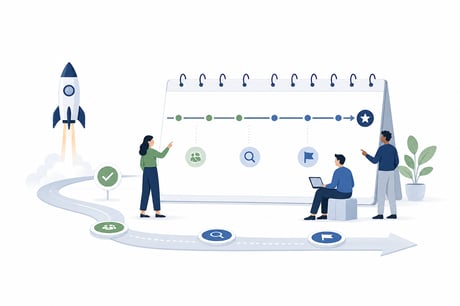
The Post-Launch Accountability Period is a 90-day operational engagement that begins the moment a product goes live. It is contracted before launch, staffed by the same engineers who built the system, and produces three outputs: a fixed-bug log, a performance baseline against measured production traffic, and a documented handover at the end that explicitly transfers operational ownership. It is not a support form. It is not a goodbye email. It is the same team, the same Slack channel, and the same accountability that existed during the build, extended through the period where the build is most likely to fail.
The period contains four overlapping streams of work.
Active monitoring runs from day one. Application performance monitoring, error tracking, log aggregation, and uptime checks are wired in before launch and watched continuously. Alerts route to an on-call rotation that includes the engineers who wrote the code, not a Tier 1 desk that will escalate after a delay. Thresholds are calibrated against the first two weeks of real production data — the team that ran the build is the team best placed to read the signals.
Bug triage runs as a parallel sprint cycle. Issues are categorised by severity on arrival, with critical bugs (data loss, payment failures, security exposure) targeting same-day fixes and high-severity bugs targeting same-week. The triage log is visible to the client, with every bug carrying an owner, a state, and a resolution timestamp. The discipline that matters is not that bugs are zero — they will not be — but that the queue is being worked.
Performance optimisation runs from day fifteen to day sixty. The first two weeks accumulate enough real production telemetry to identify the queries, endpoints, and assets that are actually slow under real conditions, as opposed to the ones the team predicted would be slow. The optimisation work targets those, not a generic checklist. Common findings in this window include missing indexes against unexpectedly large tables, oversized images served at desktop resolution to mobile devices, third-party scripts blocking the main thread, and API endpoints that need pagination.
User behaviour review runs from day thirty onward. Analytics are reviewed against the success metrics defined in the Discovery Workshop™ — conversion on the flows that mattered, retention on the features the product was built around, drop-off points where users abandoned an intended path. The work in this stream is not to ship new features; it is to surface where the launched product is and is not delivering the outcome it was scoped to deliver, so that the next phase of work is informed by evidence.
The period ends with a written handover that documents what was fixed, what was tuned, what the production baseline now looks like, what the open backlog is, and what an in-house team needs to know to operate the system without the build team in the room. This handover is the bridge between the accountability period and whatever long-term arrangement follows.
Even when the period is in place, three failure modes recur. The on-call rotation can exist on paper but route to engineers who have already moved to other projects and cannot prioritise the page. The bug log can be tracked but never pruned, accumulating low-severity issues that crowd out the visibility on the critical ones. And the performance work can be done in a vacuum without reviewing the metrics that motivated the build, which produces a faster product that misses the original commercial point. Each is addressable, and none is solved by a clause in a statement of work.
How to set up the period before you launch
The Post-Launch Accountability Period is contracted before the build is signed off, not after launch is missed. Three weeks before go-live, the practical work begins. The team confirms the monitoring stack is configured against production, the alert thresholds are written down, and the on-call rotation has named engineers with hours and timezones. The bug triage workflow is documented — severity definitions, owner assignment, resolution targets, escalation path — and the channel the client uses to log issues is the same channel the build team has been using throughout the engagement.
The first week after launch is the operational acceptance window. The team is in active observation mode. Every alert is responded to inside the agreed window, every reported bug is triaged inside the day, and a brief is written at the end of week one summarising what was observed, what was fixed, and what was deferred. The brief goes to the client decision-maker who signed the Locked Scope Document™ and is the basis for the conversation about whether the launch is holding.
Weeks two through six are the bug-fix and tuning window. Critical defects are fixed under same-day or same-week SLA. The performance baseline is established against fortnight one of real data, and the optimisation backlog is prioritised against that baseline. The team meets weekly with the client, with a written status that names what shipped, what is in progress, and what is queued. Implementation depends on the monitoring stack that was set up during the build, on the CI/CD pipeline that allows hotfixes to ship the same day they are written, and on the Named Account Lead who is the single point of escalation throughout the period.
Weeks seven through twelve shift toward optimisation and review. Performance work concludes against the baseline. Analytics are reviewed against the original success metrics. The handover is drafted, reviewed, and signed at the end of week twelve. If a longer-term arrangement is being negotiated — managed support, embedded squad, or staff augmentation — the conversation runs in parallel through this window so the transition is continuous rather than abrupt.
The most common implementation mistake is to scope the period too narrowly — to commit to bug fixes only, without performance work or analytics review. The bug fixes will get done, the product will not get better, and the engagement will be remembered as a warranty rather than as a partnership. The second most common mistake is to staff the period with engineers who were not on the build. They have to learn the system before they can fix it, and the learning curve eats the first month. Use the same team, and the response time is hours, not weeks.
A composite of two launches, twelve months apart
A mid-sized Australian SaaS client we worked with launched a workflow product to a closed beta of around 400 users in their first engagement. The agency moved to the next project at launch and provided a support email for escalation. Within three weeks the beta surfaced two issues: a tenancy isolation bug that occasionally let users see metadata from another customer's account, and a queue-processing delay that meant notifications were arriving with a multi-hour lag. The support response on both was around five working days. The tenancy bug, in particular, eroded enterprise prospect trust, and three deals in the pipeline stalled while the client team waited for fixes. The product survived, but the first twelve weeks of revenue ramp were lost.
The same client engaged us for a second product the following year, and this time the engagement scoped a 90-day accountability period from the start. The same engineering team that wrote the code was on the on-call rotation for the first twelve weeks. Monitoring was wired in before launch, with alert thresholds calibrated against the first fortnight. Two critical defects surfaced in week one — a payment-webhook idempotency issue and a slow query on a dashboard that grew with tenancy count — both fixed inside 48 hours. Performance tuning in weeks three through six brought the slowest endpoint from around twelve seconds at the 95th percentile to under two. Analytics review in weeks six through ten flagged an unexpectedly low conversion on the onboarding flow, which a small redesign addressed before the public launch in week thirteen. The retrospective at the end of week twelve recorded the team had shipped 38 bug fixes, 14 performance improvements, and four onboarding adjustments. The product entered its second quarter with a measured baseline, a documented backlog, and a client team that owned it.
When this matters most, when it can be lighter
The Post-Launch Accountability Period is critical when the product is customer-facing, when revenue depends on it from day one, when the system carries regulated data, or when the brand cost of a visible failure is high. Payments, healthcare, regulated finance, and any consumer product with a large initial audience all sit in this bracket. The 90-day commitment is not a luxury for these systems; it is the difference between a product that earns trust in its first quarter and one that spends its first quarter losing it.
It can be lighter for internal tools with a small, known user base where the operational team is already in place. A back-office reporting tool launched to thirty internal users with an engineering manager who owns it does not need a 90-day external commitment of the same intensity. Even there, a 30-day check-in covering bug triage and performance review is worth scoping; the failure modes are the same shape, just at a smaller scale. It is rarely sensible to skip the period entirely. Even the most stable launches surface unexpected behaviour against real users, and the cost of catching a problem in week two is an order of magnitude lower than catching it in month six.
What to do next
If you have a launch on the horizon and the statement of work ends at go-live, the action this week is to scope what the next 90 days look like before the contract is signed. Name the engineers on the on-call rotation, write down the alert thresholds, define the severity tiers and SLAs for the bug triage workflow, and decide what the success metrics will be measured against during the optimisation window. The single most useful adjacent reading is the broader framing of how we deliver custom software, which sets out where the accountability period sits in the end-to-end delivery flow. The component most BTL teams pair with this one is the Structured Handover Package, because the handover at day 91 is what makes the period defensible.
Frequently Asked Questions
What happens after launch, in practical terms?
A defined 90-day operational engagement, contracted before launch, staffed by the same engineers who built the system. The work runs in four overlapping streams: active monitoring with on-call coverage, bug triage with severity-based SLAs, performance optimisation against measured production traffic, and user-behaviour review against the success metrics defined at the start of the engagement. The period ends with a written handover that records what was fixed, what was tuned, and what an in-house team needs to operate the product without the build team in the room.
Who is supporting us during the 90 days?
The same team. A Named Account Lead is the single point of escalation, the engineers who wrote the code are on the on-call rotation, and the channel the client uses during the build remains active. This is the difference between a 48-hour response time and a same-day fix on the bugs that matter. Substituting a fresh team at launch produces a four-to-six-week learning curve during the window where speed of response is most valuable.
How do we know if the launch is actually working?
By comparing real production telemetry to the success metrics defined in the Discovery Workshop. Active monitoring produces a performance baseline against fortnight one of traffic. Analytics review from day thirty onward measures conversion, retention, and drop-off on the flows that mattered. A weekly written status names what shipped, what is in progress, and what is queued. The end-of-period retrospective records the count of fixes, optimisations, and adjustments delivered against the baseline.
When do we start making improvements, and when do we leave things alone?
Critical and high-severity bugs are fixed continuously through the period. Performance optimisation begins around day fifteen, once two weeks of real telemetry are in. New feature work is held off until after day ninety in most cases — the point of the period is to consolidate the launched product against measured behaviour, not to expand it. The discipline that matters is to make changes against evidence, not against assumption, which means resisting the impulse to ship feature requests in the first month before the telemetry is sufficient to support them.
How is this different from a support contract?
A support contract typically begins after launch is closed out, runs against ticket-based SLAs, and is staffed by a different team than the one that built the product. The accountability period is contracted before launch, runs with the same team, includes proactive performance and analytics work rather than only reactive bug fixing, and concludes with a written transfer of ownership. The two are not interchangeable — a managed support arrangement is what often follows the 90-day period, but it does not replace the period itself.
What does the engagement look like at day ninety-one?
Do we still need this period if the build passed its readiness review?

Gorakh excels in leadership and web development, driving excellence. Always ready for new challenges, he fosters growth for himself and his team.
Read more Articles by this Author