
12 Jun 2026
Author
Yangjee Rai Shrestha


A prompt change ships on a Tuesday afternoon. One engineer edits a system instruction in a shared document, copies the new text into the application config, pushes the update. The change is small. The reasoning is sound. No code review, no regression test, no record. Three weeks later customer success surfaces a complaint about an AI assistant making the wrong product recommendation. The engineering team investigates, fails to identify the cause for a fortnight, then traces it back to the Tuesday change nobody flagged as a deployment because nobody recognised it as code.
This is the failure pattern prompt version control exists to prevent. The discipline is not exotic. It is the same one any competent engineering team applies to any artefact that determines production behaviour: source control, code review, automated tests, gated deployment, traceable rollback. The novelty is that the team has to recognise the prompt as belonging in that category at all.
Inside the Built to Last™ 2.0 framework, prompt version control sits in P05 — The Right Code — alongside the AI Evaluation Framework, the CI/CD pipeline, and the Model Card standard. Together they convert prompt engineering from a spreadsheet exercise into AI operations.
Why prompts in a spreadsheet are a production risk
The cost of unversioned prompts is rarely a single dramatic outage. It compounds in three smaller costs that the team only notices when one of them lands inconveniently.
The first is silent regression. A small wording change can shift accuracy on edge-case inputs by several percentage points; in a system handling thousands of decisions a day, that translates into a real number of wrong outputs nobody is aware of. Without a version-controlled history and an evaluation framework running on every change, the regression is detected only when a user complains — and the complaint arrives weeks after the change does.
The second is unauditable behaviour. The team cannot answer the question "what prompt was running when that wrong answer was produced?" — and for products subject to the EU AI Act, ISO 42001, or NIST AI Risk Management Framework expectations, that question is not optional. Prompt-level provenance is part of the compliance record regulators ask for. Without it, the team is producing assertions instead of evidence.
The third is loss of operational knowledge. The engineer who tuned the prompt last quarter is the only person who fully understands why the wording is the way it is. When that engineer moves on, the prompt becomes a string nobody dares to change. The system freezes around an artefact that should be iterated against.
None of these costs are theoretical. They are conditions every team running prompts out of a shared document eventually meets.
What prompt version control actually looks like in practice
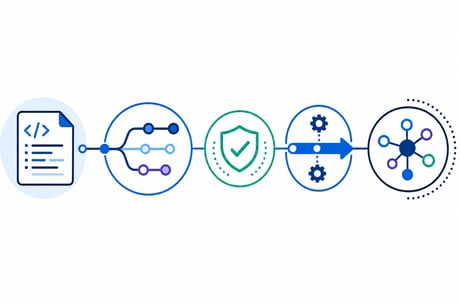
Prompt version control is a stack of practices, not a single tool. Five components define it, and skipping any one leaves a gap a regression can slip through.
The first is the canonical source of truth. Every prompt — system instruction, user template, tool definition, retrieval-augmentation snippet — lives in a versioned repository alongside the application code, with a clear directory layout and a naming convention. Not in a doc. Not in a shared spreadsheet. Not embedded in the application as a magic string nobody can find. The same Git repository the engineering team already uses, with the same access controls, branching model, and history.
The second is the change record. Every prompt edit is a commit, with a description, an author, a reviewer, and a link to the evaluation results the change was validated against. The commit history is the audit trail. For products operating in regulated regimes — financial services, healthcare, public sector — that trail is the difference between an answerable regulatory question and an unanswerable one.
The third is the evaluation gate. Before a prompt change merges, the AI evaluation framework runs against it: accuracy on the benchmark set, edge-case behaviour, hallucination rate, consistency across the model versions the system targets. If the change degrades an agreed threshold, the merge blocks. The team revises. The change does not ship because somebody on Slack agreed it looked better in the three examples they tried.
The fourth is the deployment pipeline. Approved prompts move from repository to runtime through the same CI/CD pipeline application code uses. Same gates, same approvals, same rollback path. A bad prompt is reverted the way a bad code change is reverted — by a commit, not by an engineer remembering what the wording used to be and pasting it back from memory.
The fifth is runtime traceability. Every model call in production logs the prompt version that was used. The day a wrong answer surfaces, the team can answer immediately: what prompt was in effect, when did it change, who reviewed it, what did the evaluation results say. The trace is not bolted on after an incident. It is a property of the pipeline.
Who is in the room
A prompt version control system implemented well has three roles agreed at the outset. The AI engineer who designs the prompts. The MLOps or platform engineer who owns the pipeline. And the named approver — usually the technical lead or CTO — who owns the gate for changes affecting production behaviour. Without that gate named explicitly, version control degenerates into history without governance. The history is necessary; it is not sufficient.
What gets documented
Each prompt has a short accompanying artefact: intent, target model and version, the evaluation set it has been validated against, known edge cases, last-reviewed date. A few hundred words, not a novel. The next engineer should be able to read the artefact and understand why the prompt is shaped the way it is. The Model Card sits beside it for full-system documentation; the prompt artefact is the operational layer underneath.
Failure modes even when version control is present
The discipline fails most often in three ways. The parallel doc — prompts are version-controlled in the repository, but engineers iterate on a shared document and only commit the final wording. Every interim change in the doc that never made it back to the repository is a regression risk that wasn't tested. The missing evaluation gate — prompts are committed and merged, but the evaluation suite runs manually, inconsistently, or against an out-of-date benchmark. The runtime drift — the prompts in the repository are correct, but the application reads from a configuration store last synchronised three releases ago. Repository and runtime diverge silently. Each of these is preventable. None of them are uncommon.
A concrete example
Picture a customer-support assistant whose system prompt encodes tone, scope, and escalation rules. An engineer wants to widen the assistant's scope to handle a new category of question. They branch the prompt repository, edit the system instruction, commit. CI runs the evaluation suite: 200 benchmark questions across the existing categories, 50 new questions covering the expanded scope, a hallucination check on 30 adversarial inputs. Accuracy on existing categories holds at the agreed threshold; the new category passes; the hallucination rate ticks up by half a percentage point — still under the limit. The reviewer approves. The pipeline moves the new prompt version into the configuration store; the application picks it up on the next request. Two days later a user reports an unusual answer. The team checks the runtime log, sees the prompt version, pulls the commit, reviews the evaluation results from that commit, and traces the cause in minutes rather than weeks. That is the deliverable.
How to put prompts under production discipline
The implementation path is more cultural than technical. The tooling exists — LangSmith, Humanloop, Helicone, PromptLayer, Weights & Biases Prompts, plus the option to assemble a workflow from Git and a configuration management layer. The harder problem is treating the prompt as code at the team level from day one rather than retrofitting the discipline after the first silent regression.
Start with the repository. Pick a directory layout — by feature, by model, by deployment surface — and move every prompt currently in a document or string literal into it. This is not glamorous work, and it will surface prompts the team forgot existed. That is part of the value of doing it.
Wire the evaluation framework into CI before you wire it into approval gates. Run the suite on every prompt change for a few weeks. Watch the curves. Tune the thresholds so the suite catches regressions you care about and ignores noise you don't. Only then make the suite blocking. A blocking gate against a noisy evaluation is worse than no gate at all — the team will start bypassing it.
Define the approval roles. Who reviews a prompt change to a customer-facing surface? Who approves a system instruction change to an internal tool? Write the answer down and commit it to the repository alongside the prompts. Decisions made under deadline pressure default to the path of least resistance; the path of least resistance has to be the right one by design.
Add runtime traceability before you need it, not after the first incident. Every model call logs the prompt version, the model version, the input, and the output. Log volume will surprise the team in the first month; the team will adjust retention and sampling. The first time the trace earns its cost is the day a user reports an issue and the answer is available in seconds rather than weeks.
Avoid three traps. First, do not let prompts diverge between environments. Same version control, same approval gates, same evaluation suite for development, staging, and production. Differences here mean regressions are detected late. Second, do not let prompt size grow unchecked because revision is cheap. A prompt that doubled in length over six revisions has accumulated edge-case patches; refactor them into structured guardrails rather than longer instructions. Third, do not couple the prompt repository so tightly to one vendor's framework that switching models becomes a refactor. Vendor lock-in at the prompt layer is the AI equivalent of lock-in at the database layer.
Implementation pairs with three other Built to Last components: the AI Evaluation Framework provides the gate that makes the change record meaningful, the CI/CD pipeline gives prompts the same delivery path as the rest of the application, and the Model Card standard captures the full-system context the prompt sits inside. Our approach to delivering agentic AI treats all three as standard infrastructure rather than optional extras, in the same way our DevOps practice treats deployment gates and rollback as build-time deliverables rather than launch-week firefights.
A composite from two builds
A mid-sized SaaS client we worked with had built an AI-augmented internal tool serving a small number of high-volume decisions. The prompts lived in a shared document; one engineer maintained them; changes were made in the doc, copied to the configuration file, and deployed. The team had no evaluation suite and no runtime trace of which prompt was in effect at what time. The build worked at launch; six months in, an internal user flagged that the assistant's answers had become noticeably less useful. The team investigated for three weeks before identifying that a single edit — made during a busy fortnight and not regression-tested — had narrowed the prompt's interpretation of one common input pattern. In scenario terms, accuracy on a measured benchmark fell by around eight percentage points and went unnoticed for the better part of a month. They reverted, but the reversion was painful: the doc had moved on, the runtime had no record of what the original looked like, and the team had no way to confirm whether the reverted version matched the launch version exactly.
The same team's next AI build was structured differently. Prompts in the repository from sprint one. Evaluation suite running on every commit. Runtime logging of the prompt version on every call. Six weeks in, the suite caught a comparable regression on a similar kind of edit in a single test cycle, before merge. The change was revised; the deployment never happened. The cost of catching that regression was a single test run.
When this matters most, and when you can defer it
This matters most under three conditions. AI decisions are user-facing or commercially significant, so silent regressions translate into real harm. The system operates under the EU AI Act, ISO 42001, NIST AI RMF, or sector-specific regulation, where prompt-level provenance is part of the compliance record. Or the team has more than one engineer touching prompts — concurrent edits without version control eventually collide.
When can it wait? Genuine prototypes — a build the team intends to throw away after testing one hypothesis, with no production traffic — can survive on a shared document for a sprint. Internal experiments where a wrong output is a curiosity rather than a cost. Single-engineer builds at the earliest stage, where everyone understands the discipline arrives the moment a second engineer joins.
The honest broker view: this is one of the disciplines teams defer for longer than they should. The first regression that needs to be traced is usually the moment it becomes clear the trace does not exist. Build it before that moment, not after. Our agentic AI engagement pricing treats prompt version control as part of the standard build scope, not an upgrade option, for the same reason.
What to do next
If your prompts currently live in a document, a spreadsheet, or a string literal inside the application, book the hour this week to move them into the repository the rest of your code lives in. That single move is the prerequisite for everything else in the discipline. Evaluation gates, approval roles, and runtime traces can be wired in the sprints that follow. To see where prompt version control sits inside the wider AI delivery pipeline, our AI app development practice walks through where it fits, and our project delivery framework shows how the same discipline maps onto sprint cadences readers already know.
Frequently Asked Questions
Why treat prompts as code?
Because they determine production behaviour. A prompt change can shift accuracy, change tone, alter safety properties, and reshape the system's interpretation of edge cases. Anything that changes production behaviour belongs under the same controls the rest of the production code lives under — source control, review, tests, traceable deployment. The alternative is a system whose behaviour is governed by a string nobody is watching.
How do we version them?
Use the same Git repository the application uses, with a clear directory layout, a naming convention, and a short artefact alongside each prompt describing intent, target model, validated evaluation set, and known edge cases. Branch per change, commit with a description, link the commit to the evaluation results that gated the merge. The tooling is tooling the team already knows; the discipline is the addition.
How do we test prompt changes?
Through an evaluation framework run on every commit. The framework covers accuracy on a benchmark set, edge-case behaviour, hallucination rate, and consistency across the model versions you target. Tune the thresholds so the suite catches regressions you care about; only then make the gate blocking. A noisy gate gets bypassed; a calibrated gate gets respected.
What's the deployment process?
Approved prompts move from the repository to runtime via the same CI/CD pipeline application code uses. Same approvals, same gates, same rollback. Runtime reads the prompt from a configuration store the pipeline writes to; production logs include the prompt version so any call can be traced back to the change record. The deployment is unremarkable; that is the point.
Who should approve prompt changes?
A named role, written down. For customer-facing surfaces in regulated industries, the technical lead or CTO; for internal tools, often the AI engineering lead. The role matters less than the rule that the role exists and is filled. Decisions under deadline pressure default to the path of least resistance — that path has to be the right one by design.
What if we use a managed prompt platform like LangSmith or Humanloop?
These platforms can be the canonical source of truth, the change record, or both — and they often integrate with evaluation suites out of the box. The discipline does not require Git specifically; it requires that the five components — source, change record, evaluation gate, deployment pipeline, runtime trace — are in place and connected. Whichever tool you choose, do not let prompts live in two systems with no synchronisation between them.
How does this fit with foundation-model updates we don't control?

As a QA Manager, Yangjee is passionate about quality, automation, and security testing. She thrives on continuous learning to deliver exceptional software.
Read more Articles by this Author